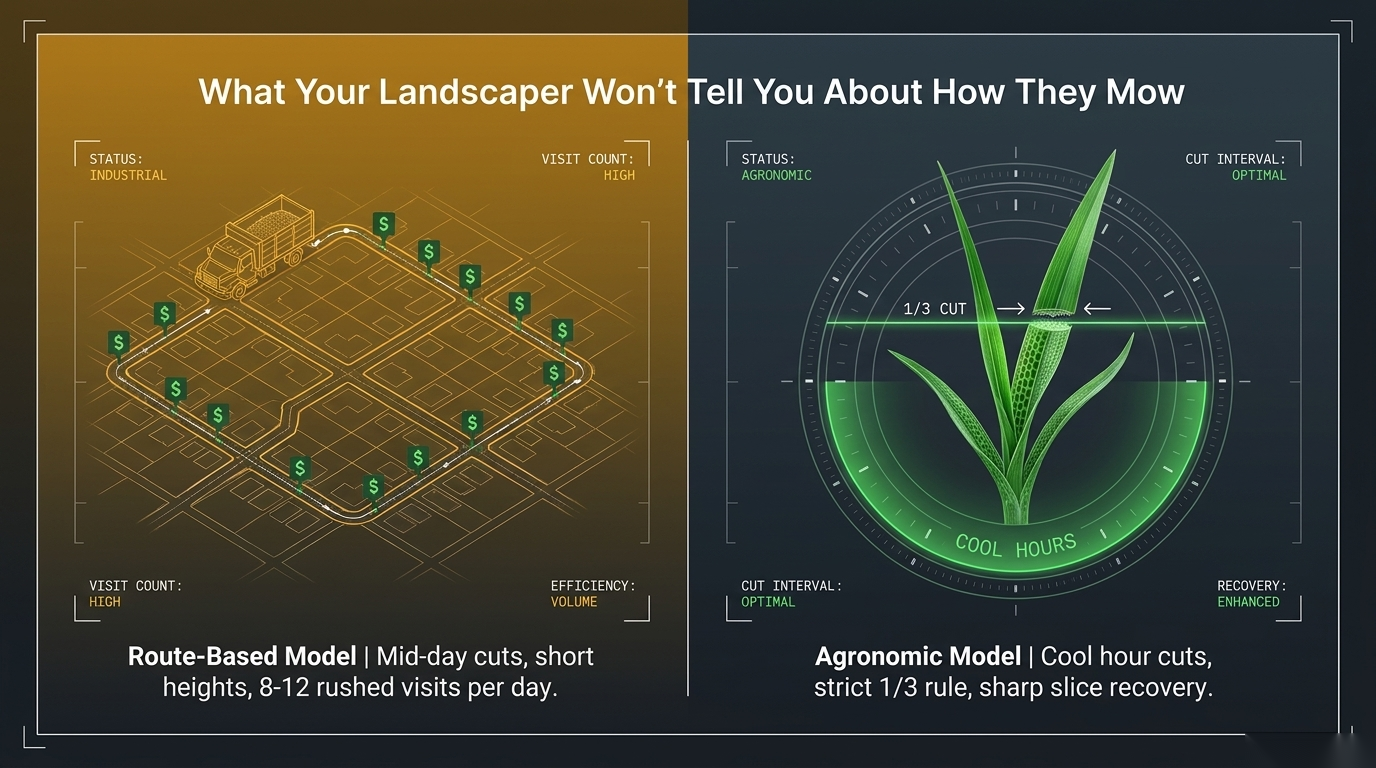
You pay $40 to $60 a visit. The crew shows up mid-morning on a hot day, drops the deck low, blasts through the property in twenty minutes, blows the clippings off the driveway, and is gone. The lawn looks sharp for a day or two. Then the tips brown, the color fades, and by the weekend it somehow looks worse than before they came. That is not bad luck — it is the predictable result of how a route-based lawn business has to operate.
We have written before about the three summer mowing mistakes homeowners make — afternoon heat, scalping, and over-watering. This is the other side of that coin. When you hand the job to a crew, you do not eliminate those mistakes. You hand them to someone whose entire incentive structure pushes toward making them. Understanding why is the first step to getting a better lawn out of the money you are already spending.
Habit 1: They cut too short on purpose
Cutting the grass shorter buys the crew time. A lawn scalped to two inches takes longer to grow back to the point where it looks shaggy, which means more days before the client notices and more days the crew can skip the visit. A lawn maintained at the correct three-and-a-half to four inches reaches that threshold faster and has to be visited more often. Taller grass also slows the mower down, because the deck has more canopy to process per pass.
None of this is a secret in the industry. It is simply the math of running a high-volume route. The shorter cut is more profitable per account, and the damage it causes — shallower roots, soil exposed to surface heat, an open door for weed seeds that need light to germinate — does not show up until days later, when the crew is long gone and the connection to the mow is no longer obvious to the homeowner.
"The crew is not paid to grow a healthy lawn. They are paid to make it look cut. Those are not the same job."
Habit 2: They mow on a route, not on a clock
A crew's schedule is built around geography and daylight, not plant biology. They start early, work a tight loop of neighborhoods, and finish by early-to-mid afternoon. Wherever your house falls on that loop is when your lawn gets cut — and the one window they can never reach is the one the grass actually wants: early evening, after the heat breaks, when a fresh cut has the whole cool night to recover before the next day's sun.
The one stretch to avoid is peak heat itself — roughly midday through mid-afternoon, when vapor pressure deficit hits its high and a freshly cut blade loses the most moisture it ever will. Three in the afternoon on a July day is the brutal extreme of that window. A mid-morning cut around 8 a.m., once the dew has burned off, works perfectly well — the grass is dry, the blades slice clean, and the worst heat is still hours away. But a route-based crew rarely controls for any of this. The early-route houses often get mowed while the grass is still wet with dew, which tears the blade instead of slicing it, and the midday houses get cut at the exact peak-stress hour. The crew cannot fix this without rebuilding their entire route around the biology of each individual lawn — which no volume business can afford to do.
A lawn recovers best when it is cut as the day cools — early evening — so it can seal its tips overnight before the next wave of heat. That window is the end of a crew's workday: cutting then means fewer lawns, more labor hours, thinner margins. So the optimal time for your grass is the worst time for their business, and the business wins. They cut when the route says to, which on a hot day often lands in the peak-stress hours the grass can least afford.
Habit 3: Dull blades nobody sharpens
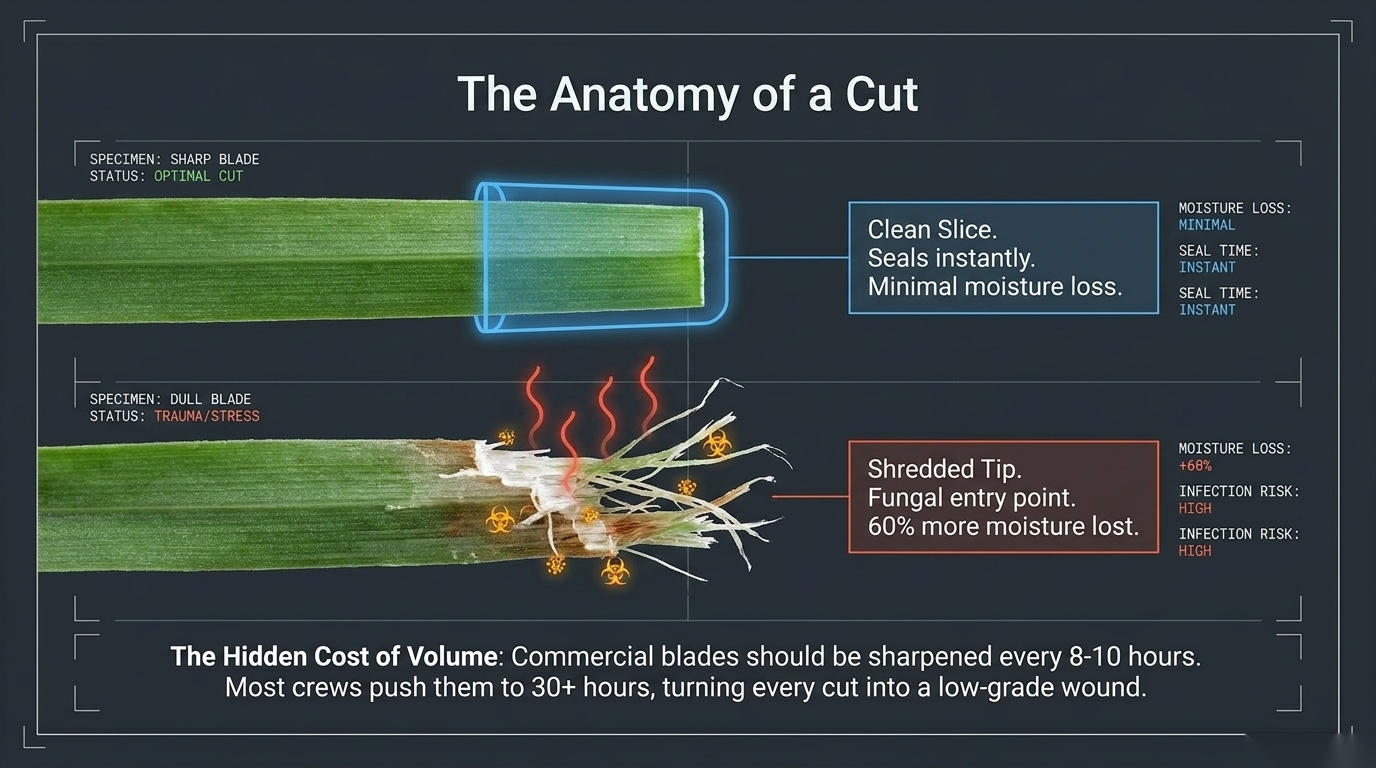
A clean slice seals instantly. A shredded tip loses far more moisture and invites disease.
This is the one almost no homeowner checks, and it may do the most damage. A sharp mower blade slices the grass cleanly; a dull blade rips and shreds it. You can see the difference yourself — get down close after a mow and look at the cut tips. Clean cuts look like a straight green line. Dull-blade cuts look white, frayed, and ragged.
Commercial blades should be sharpened roughly every eight to ten hours of use. A crew running eight to twelve lawns a day burns through that in two or three days. Most sharpen weekly at best; some monthly. Shredded tips lose far more moisture than cleanly cut ones and serve as open entry points for fungal diseases like brown patch and dollar spot — both active in Chicago's humid summers. A dull blade turns every mow into a low-grade wound the plant has to fight off in the heat.
Habit 4: The same deck cuts every lawn on the block
This one came from a homeowner we interviewed directly, and it is not something we had considered until he raised it himself. He had been fighting a persistent weed problem despite paying for regular cutting service, and after talking to neighbors, formed his own theory about why.
"Talking to other people, I realized maybe some of the issue of getting weed is the same machine that cuts all that weed area comes into my yard and spreads some of the spores while they cut it, using the same machine."
He is describing something real. A route crew's mower deck, wheels, and undercarriage move from lawn to lawn all day without being cleaned between stops. Seed heads, spores, and plant fragments genuinely do cling to mower decks and wheel treads — it is a well-documented vector for weed and disease spread in commercial turf management, which is exactly why golf course superintendents and sports-field crews often follow strict equipment sanitation protocols between zones. A residential route crew, running eight to twelve properties before lunch, has no such protocol and no time built in for one. The same deck that just cut a weed-heavy yard rolls directly onto the next lawn on the route.
The homeowner does not need to prove this is happening on every visit to be right about the underlying incentive. Cleaning a mower deck between stops costs time a volume route cannot spare, in the same way sharpening a blade or slowing down for a hydrated cut does. It is one more small, invisible cost that gets absorbed by the lawn instead of the schedule.
The frequency problem nobody measures
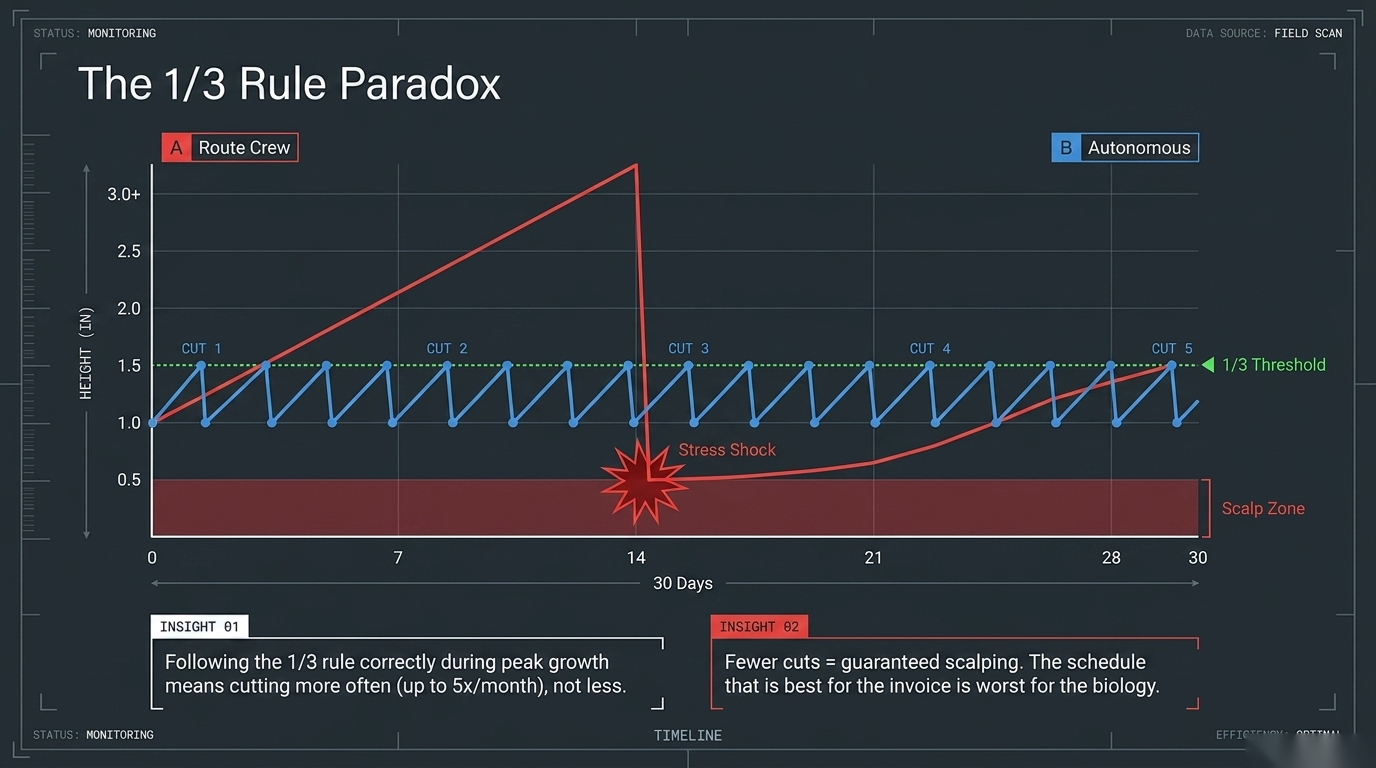
Cutting on a budget cadence forces a scalp every visit. Cutting at the threshold never does.
Here is the counterintuitive truth at the center of all of this. Following the one-third rule correctly does not mean cutting less — it means cutting more often. If you can only ever remove a third of the blade at a time, then during peak spring and early-summer growth, keeping the lawn at its ideal height might require five cuts in a single month, not two. The grass is simply growing that fast.
Almost nobody does this. A crew bills per visit, so five visits costs you more than two — and a homeowner doing it themselves is trying to reclaim their weekend, not spend three of them mowing. So the lawn gets cut on a convenient cadence, twice a month, and by the time the crew arrives the grass has grown well past the one-third threshold. Taking it back down to "looks neat" now means removing half the blade or more in a single pass. The infrequent schedule does not protect the lawn from stress — it guarantees it.
"Fewer cuts feels gentler. It is actually the opposite. The lawn that gets cut on a budget is the lawn that gets scalped every single time."
And nobody is measuring it. No one is standing in the yard with a ruler deciding that today the grass has grown exactly one-third and it is time to cut. The schedule is set by the invoice, not by the plant. The result is a lawn that is chronically cut too much, too late, in the name of saving money — when the saving is the very thing causing the damage.
LawnSentinel cuts exactly when the lawn crosses the one-third threshold — twice in a slow month, five times in a fast-growing one — and every one of those cuts costs you nothing extra. There is no per-visit invoice. The faster your lawn grows, the more cuts it needs, and the more value you get out of a machine that delivers each one at zero marginal cost. The math actually improves the more the lawn would have cost you in landscaper visits. You finally get the lawn cut precisely when it needs it, which is the one thing the pay-per-visit model can never afford to give you.
There is one more lever, and it is the honest one. If cutting frequency is genuinely a burden, the right answer is not to skip cuts and scalp — it is to plant grass that grows more slowly. Dwarf and low-growth-rate seed blends genuinely reduce how often a lawn needs cutting, without the stress that comes from letting it overgrow and then scalping it. LawnSentinel treats this as one factor it monitors and recommends per lawn: based on how your specific turf is growing, it can tell you whether working a dwarf blend into your overseeding mix would cut your mowing frequency at the source. Our goal was never to reduce cuts at the cost of your lawn's health. It is the best-looking lawn on the block — and sometimes the path to that runs through smarter seed, not a longer leash between mows.
How to get a better lawn from the crew you already pay
You do not necessarily need to fire your landscaper. You need to give them the two or three specific instructions that the default route does not include, and then verify they happened:
- Ask for a specific height. Tell them three-and-a-half inches minimum from June through September, and check it yourself with a ruler after the first mow at the new setting.
- Ask when they sharpen blades. If the answer is vague, that is your answer. A good company will know.
- Water the evening before a hot-day mow. You control irrigation even if you do not control their schedule — a fully hydrated plant handles a mid-morning cut far better than a dry one.
- Watch the cut tips. Ragged white ends after a mow mean dull blades. Bring it up. A crew that cares will fix it.
- Ask if they wash the deck down between weedy properties. Most crews won't have an answer ready. If your weeds keep coming back despite treatment, this is worth asking about directly.
Get the LawnSentinel seasonal lawn calendar
Monthly agronomic guidance for Illinois cool-season turf — what to do, when to do it, and why the biology supports it. Free, no commitment.
No spam. One email per month. Unsubscribe anytime.
The deeper problem: incentives, not people
Most landscapers genuinely care about their work. The problem is structural. A business paid by the visit, running a tight route to stay profitable, will always be pulled toward the fast cut over the correct one — because the homeowner cannot tell the difference in the moment, and the consequences surface days later with no obvious cause. The incentive rewards the appearance of a cut lawn, not the health of the grass plant underneath it.
This is the exact gap LawnSentinel is built to close. An autonomous mower has no route to finish and no reason to scalp. It follows the one-third rule on every pass because the algorithm enforces it, not because someone remembered to. It mows at the biologically optimal window because it is not racing daylight across a dozen properties. It monitors its own cutting performance and flags when blades need attention. And because it is measuring soil moisture and turf health continuously, it is making decisions based on what the lawn actually needs that day — the way an agronomist would, on a property they only have to think about one of.