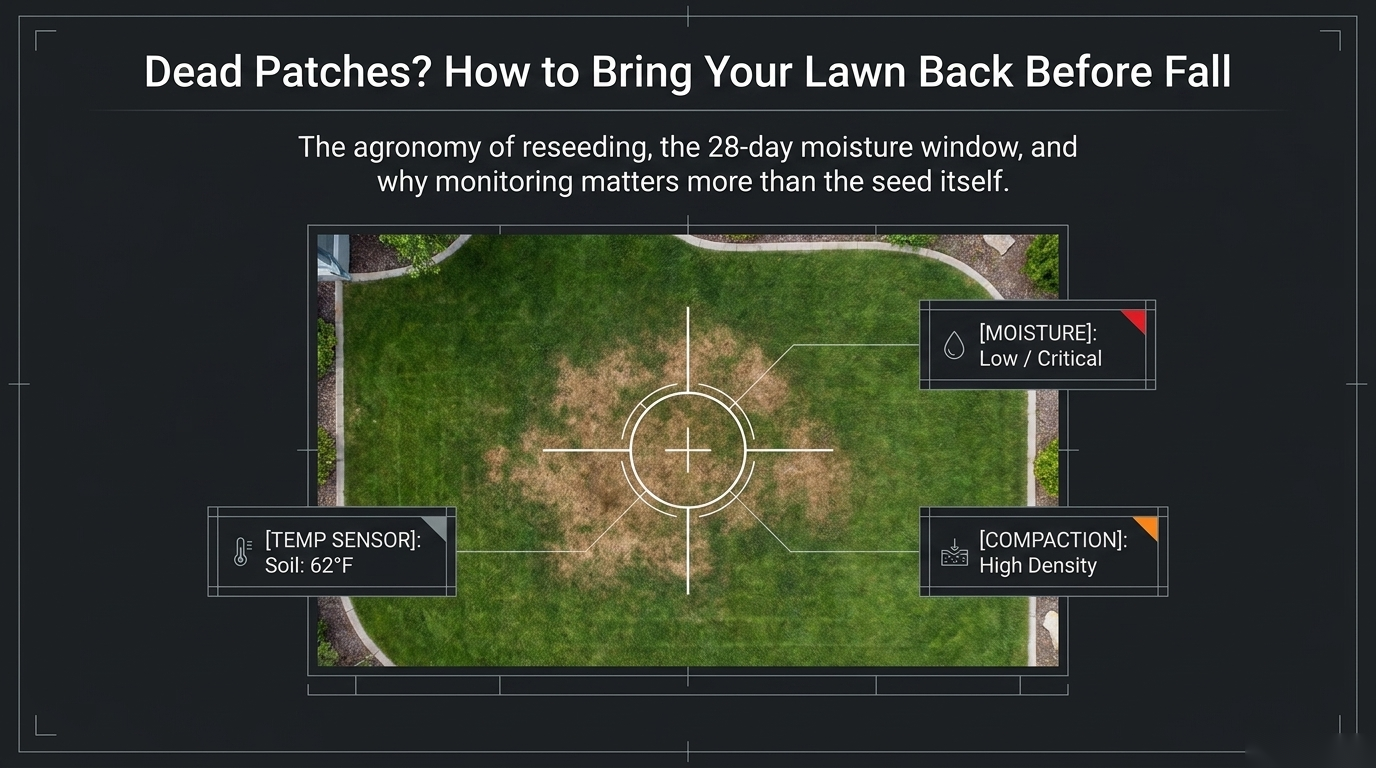
If you are looking at bare dirt and brown patches right now, you are not alone. The dry stretch hitting the Chicago suburbs has exposed every weak spot — thin areas, compacted soil, places where the mower scalped, old dog damage, high-traffic paths. The grass that was hanging on has given up, and the weeds that thrive in heat are already moving into the empty space.
The instinct is to throw seed at it right now. That instinct is half right. Bare soil is an open invitation for crabgrass and nutsedge, so you do need to fill it. But seeding at the wrong time, with the wrong species, or without understanding what killed the grass in the first place means you are spending money to watch seed fail. Here is how to do it correctly.
First: figure out why it died
A dead patch is a symptom, not a diagnosis. Throwing seed on a dead patch without understanding the cause is like putting a bandage on a wound you have not cleaned. The seed germinates, the same problem kills it again, and you are back to bare dirt in six weeks.
The four most common causes of dead patches in suburban Chicagoland lawns each need a different fix:
- Compacted soil: Foot traffic, play areas, or heavy equipment have made the soil so dense roots cannot penetrate. Needs aeration before overseeding.
- Scalp damage: Mowed too short, repeatedly, during heat stress — the crown of the plant dies. Needs correct mowing height going forward.
- Fungal disease: Brown patch and dollar spot, both active in humid June conditions. Look for a tan ring pattern or small straw-colored circles. Clear the infection before seeding.
- Drought stress in thin areas: Spots that were already weak just could not survive the dry stretch. The simplest fix — seed, water, patience.
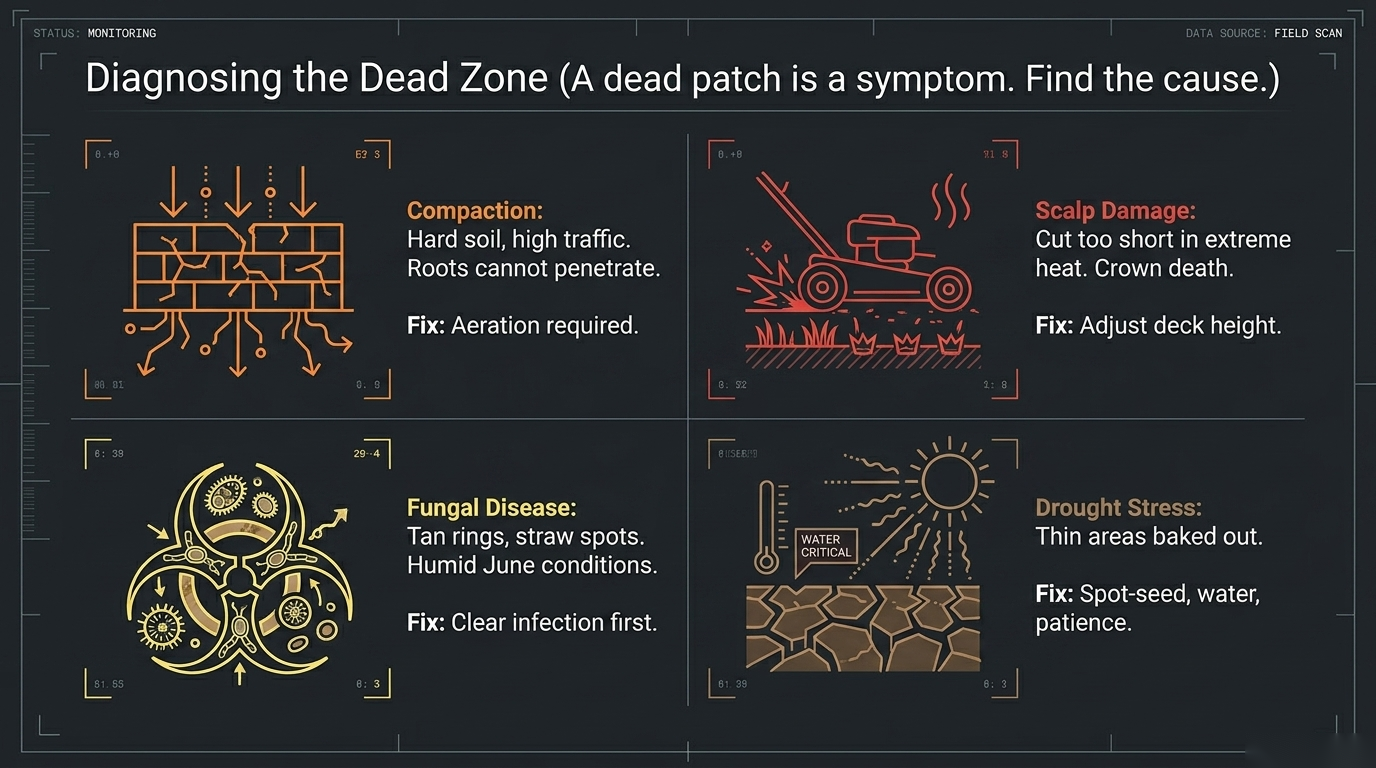
The four most common causes of dead patches — each needs a different fix.
The right seed for Illinois
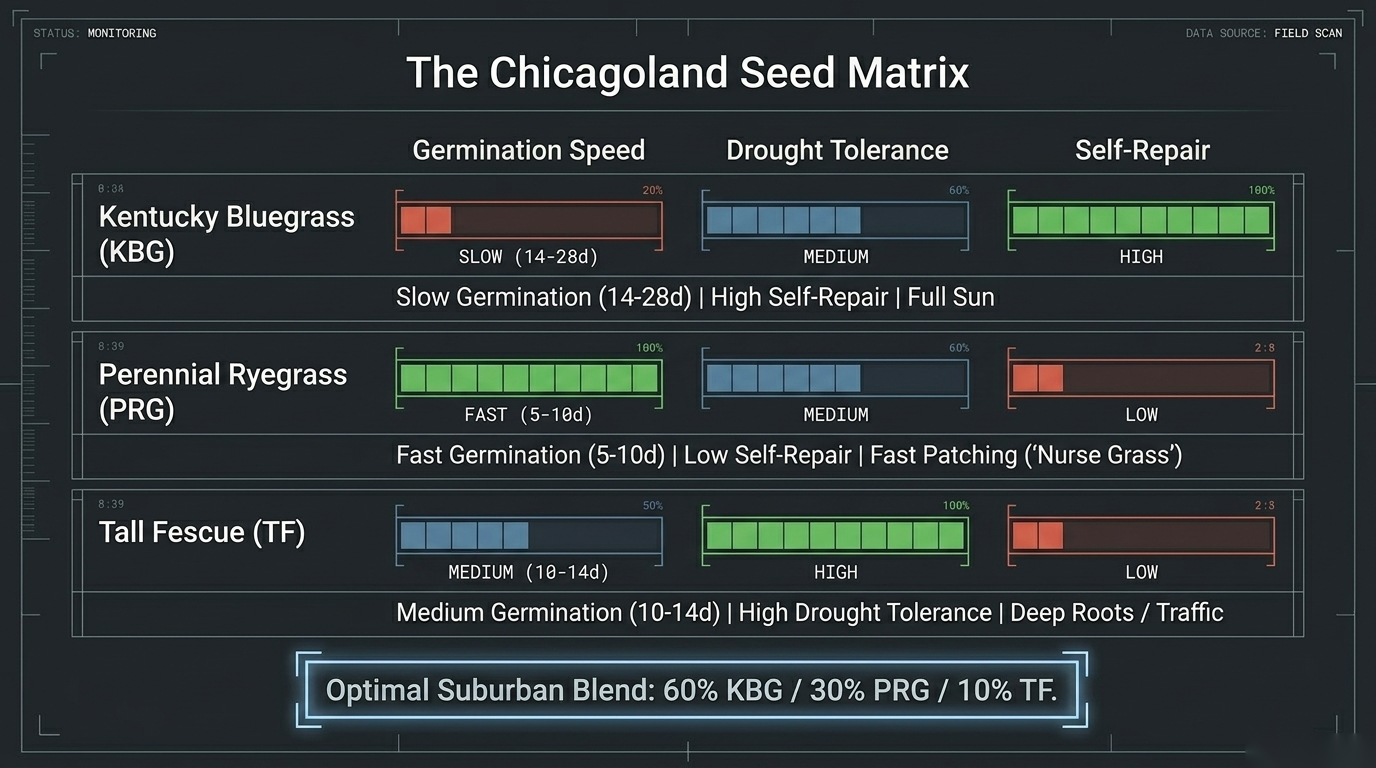
Chicago sits squarely in the cool-season grass zone. The grasses that thrive here are Kentucky Bluegrass, Perennial Ryegrass, and Tall Fescue. Each has different strengths, and the best approach for most suburban lawns is a blend that combines them.
Our recommendation for most Chicagoland lawns
A 60% Kentucky Bluegrass / 30% Perennial Ryegrass / 10% Tall Fescue blend gives you the best of all three. The Bluegrass provides the self-repairing rhizome network and dense appearance, the Perennial Ryegrass germinates fast and fills bare spots quickly (buying time for the slower Bluegrass), and the Tall Fescue anchors high-stress zones with deep roots. Look for "sun and shade" or "premium" blends from established brands, and avoid cheap contractor mix — it is often loaded with annual ryegrass that dies after one season.
One more thing to consider: how fast it grows
Seed selection is not only about color and durability — it is also about how often you will have to mow what grows back. Following the one-third mowing rule correctly means cutting more often during peak growth, not less, and a fast-growing blend can mean five cuts in a single month. If reseeding is a chance to change that, it is worth taking. Dwarf and low-growth-rate cultivars genuinely reduce how often a lawn needs cutting — without the stress that comes from letting fast grass overgrow and then scalping it back. This is one factor LawnSentinel monitors and recommends per lawn: based on how your specific turf is growing and how often it is crossing the one-third threshold, it can tell you whether working a dwarf blend into your overseeding mix would cut your mowing frequency at the source. The point is never fewer cuts at the cost of a healthy lawn — it is choosing grass that simply needs them less often.
The best time to overseed in Illinois is late August through mid-September, when soil temperatures sit between 50°F and 65°F and air temperatures are dropping. If you are looking at bare patches right now in June, you have two options: do a light spot-seed now with Perennial Ryegrass (fast germination) to stop weed invasion, then do a full overseed in September — or wait until September and fight weeds manually until then. For most homeowners, the spot-seed-now option wins, because bare soil in June becomes crabgrass by July.
The germination timeline
Once seed is down, here is what happens if you do everything right. This assumes consistent watering — the seed bed must stay moist, not soaked, for the entire germination period.
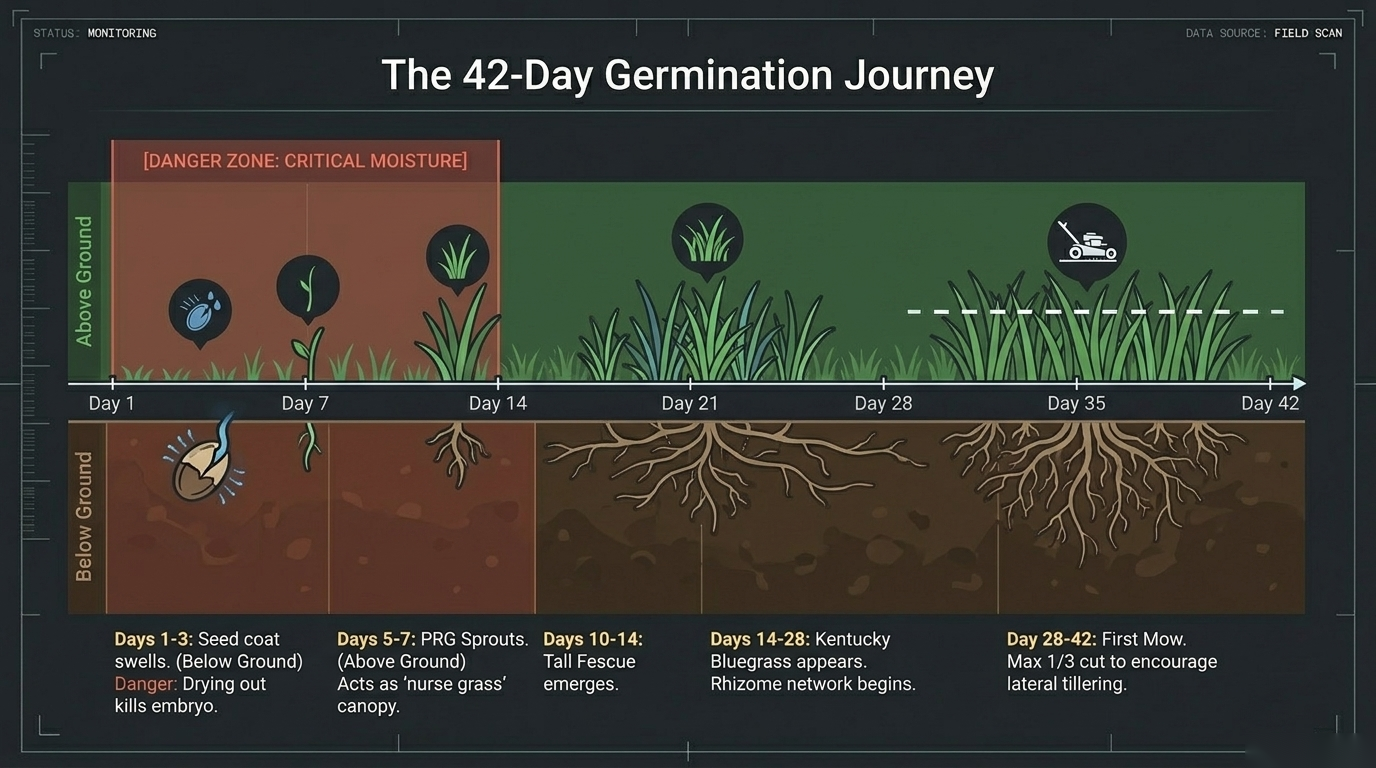
"The hard work is not the seeding. It is the 28 days after, keeping the seed bed alive while nothing is visible above the soil."
Why monitoring matters more than seeding
Here is the part most homeowners miss. The seed bed must stay consistently moist — not waterlogged, not dry — during the entire germination window. One afternoon where the surface dries out and forms a crust can kill an entire patch of germinating seed you cannot even see yet. You will not know it failed until two weeks later when nothing comes up.
This is where technology changes the equation. A soil moisture reading tells you exactly when to water and when to stop. A camera trained on the patch can detect emergence 48 to 72 hours before the human eye can — early sprouts are visible in high-resolution images long before they are visible from standing height. An NDVI reading distinguishes living green tissue from dead brown tissue at a precision that eliminates guesswork.
But the real breakthrough is what happens after you seed. Most homeowners seed a patch, water it for a week, get distracted, and find out a month later whether it worked. LawnSentinel keeps watching. It tracks the germination rate of the area you reseeded — measuring how much of the bare zone is actually filling in with living green tissue, day over day — and tells you whether the patch is on track or failing while you still have time to intervene. If germination stalls because the surface dried out, you get an alert to water. If it stalls because of compaction or disease, you get a different recommendation. The system does not just help you seed; it verifies the seed took.
This continuous germination monitoring is at the core of our patent-pending intelligence. The robot's soil sensors read moisture on every pass and the NDVI camera maps turf health at sub-meter resolution — not just before a patch dies, but through the entire reseeding recovery. It measures germination progress across the corrected zone, confirms the new grass is establishing at a healthy rate, and keeps monitoring that area afterward to catch the underlying cause before the patch comes back. The goal is twofold: ensure the seed you planted actually succeeds, and reduce the chance you ever have to reseed the same spot again.
Get the LawnSentinel seasonal lawn calendar
Monthly agronomic guidance for Illinois cool-season turf — what to do, when to do it, and why the biology supports it. Free, no commitment.
No spam. One email per month. Unsubscribe anytime.
The quick-start patch repair checklist
If you want to take action this weekend, here is the minimum viable approach for a bare patch in a Chicagoland lawn in June:
- Rake the dead material out and loosen the top half-inch of soil.
- Spread seed slightly heavier than the bag's label rate for patch repair.
- Lightly rake so about half the seeds are barely covered — good seed-to-soil contact is critical.
- Apply a thin layer of straw or peat moss to retain moisture and keep birds off the seed.
- Water lightly two to three times per day for the first two weeks, then once daily for weeks three and four.
- Do not walk on the patch for at least 30 days.
That is it. The grass does the rest. The only requirement from you is consistent moisture for 28 days and the patience to leave it alone while it establishes.