When we bought our home in the southwest suburbs of Chicago, I was handed the keys and that was about it. Nobody mentioned the lawn. Nobody explained what Kentucky Bluegrass needs in July. Nobody warned me that what works in April can kill your grass in August. I was just supposed to know.
I did not know. And over the next sixteen years, I made almost every mistake a homeowner can make with a lawn — not from carelessness, but from a genuine lack of information that should have been available and wasn't. Every mistake cost time, money, and a lot of frustration standing in the backyard wondering why the grass looked worse after I tried to help it.
"I did research. I read articles. I watched videos. I still got it wrong — because the information I needed was specific to my lawn, my soil, my climate, and my grass type. None of the general advice covered that."
— Michael O., Founder, TerraIQ Inc.The mistakes that built LawnSentinel
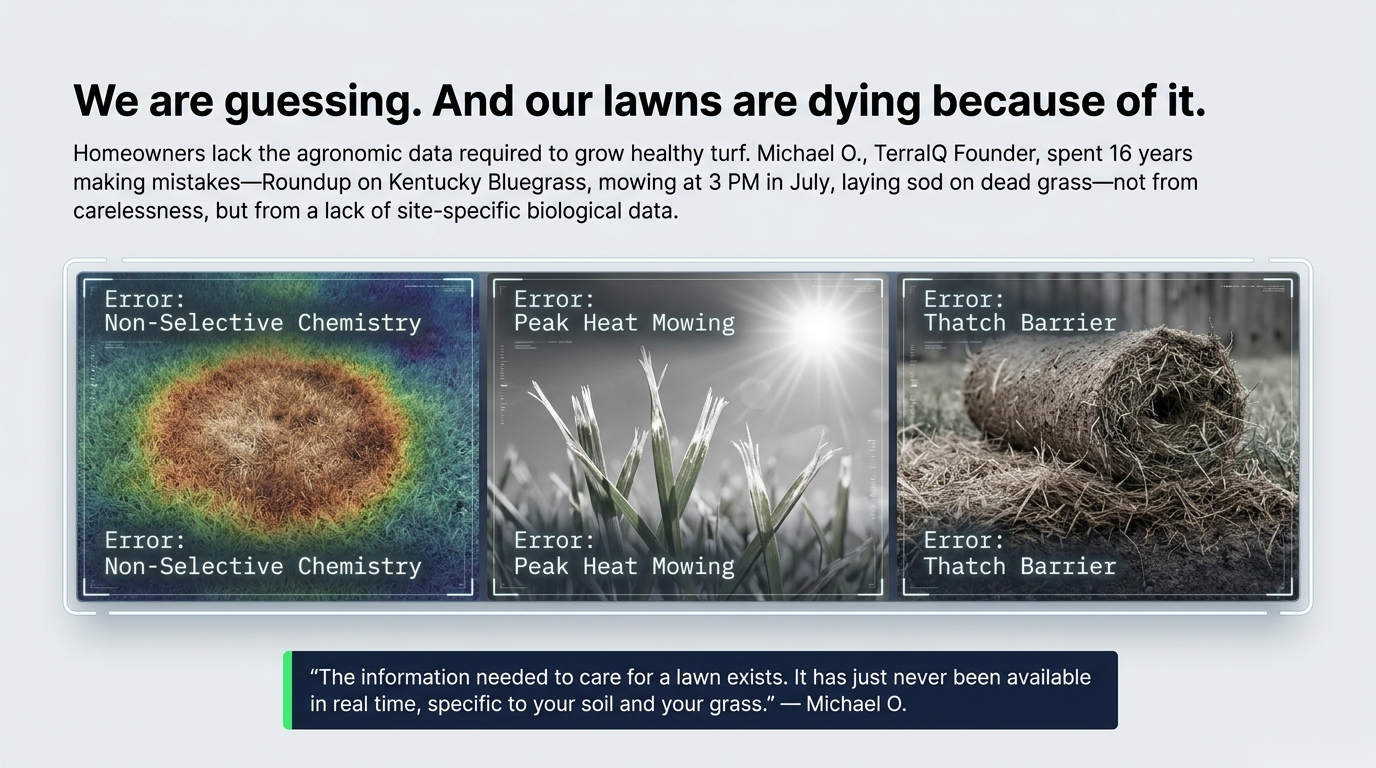
The real mistakes — made without the site-specific data that would have prevented every one of them.
I am sharing these not because they are unique to me. I am sharing them because every conversation I have had with homeowners confirms that these are the universal experiences — the moments where the gap between what we know and what the lawn actually needs becomes painfully visible.
I saw weeds. I went to Home Depot. I came back with Roundup and I sprayed everything that looked like it should not be there. Less than a week later, I had killed a significant portion of our grass too. Roundup is a non-selective herbicide — it does not distinguish between a dandelion and a blade of Kentucky Bluegrass. I did not know that. Getting the lawn back took an entire growing season and cost more than I care to admit.
💡 LawnSentinel: Species-specific AI treats only the weed. Never the grass.For years I cut the lawn whenever I had time. Saturday mornings in spring — that was fine. But in summer I would be out at 3:00 in the afternoon in 90-degree heat, running the mower because that was when I could fit it in. I did not know that mowing in peak heat severely stresses cool-season grasses. The grass loses moisture it cannot replace, the cut ends desiccate in the sun, and the lawn deteriorates over the course of the summer in ways that are not immediately obvious but compound every week.
💡 LawnSentinel: DSOA algorithm mows at the biologically optimal time, automatically.After one particularly rough season, we decided to have sod put down. I hired someone to do it. He came, he measured, he quoted, and he laid the new sod down. What neither he nor I thought to confirm was whether the old dead material needed to come up first. It did. New sod laid on top of dead thatch does not make contact with the soil, cannot establish roots, and fails within weeks. We had to do the whole job again. That was an expensive education.
💡 LawnSentinel: Soil health reports flag thatch buildup before it becomes a problem.The fertilizer aisle is overwhelming. Scotts Step 1. Scotts Step 2. Weed and Feed. Turf Builder. Winterizer. I bought many of them over the years and applied them on the dates printed on the bag — because I did not know that the right timing depends on soil temperature, not the calendar, and that soil NPK levels vary dramatically from zone to zone across a single lawn. I was applying nitrogen to areas that did not need it while the areas that did stayed depleted.
💡 LawnSentinel: Real-time NPK mapping guides exactly what to apply, where, and when.Why I decided to build what should already exist
I spent years in hardware engineering at Motorola and software leadership at a healthcare technology company. In 2025 I looked at the autonomous lawn care market and saw a curious gap: there were robots that could mow a lawn, but none of them understood the lawn they were mowing. They cut grass. They did not monitor soil chemistry. They did not detect weeds by species. They did not know what the weather was going to do in the next 48 hours or whether it was a good idea to cut at 3pm in July.
Every mistake I had made with my own lawn — and every similar story I heard from other homeowners — pointed to the same root cause. The information needed to care for a lawn well exists. Agronomists know it. Turfgrass scientists know it. Golf course superintendents have known it for decades. But it was never packaged in a form that a homeowner could access in real time, at the moment of decision, specific to their soil and their grass and their weather.
"LawnSentinel is not a lawn mower. It is an agronomic intelligence system that also mows. The mowing is the delivery mechanism. The intelligence is the product."
— TerraIQ Design Principle · 16 Patents PendingTerraIQ Inc. was founded to solve this problem. LawnSentinel monitors soil NPK, pH, moisture, and electrical conductivity on every mowing pass. It maps turf health using near-infrared NDVI imaging. It uses computer vision to identify weed species by name — not just "weeds" — so it can treat them without touching the grass around them. Its weather-adaptive algorithm knows not to cut at 3pm in July. It has a 6-state security machine that calls your phone if someone picks it up. And it does all of this autonomously, without you having to know any of what I had to learn the hard way.
The 16 patents we have filed protect the innovations that make this possible. But the real reason LawnSentinel exists is much simpler than patents. It exists because homeowners deserve to have great-looking lawns without having to become agronomists first. And because nobody should have to stand in their backyard watching their grass die because they bought the wrong product on the wrong day.