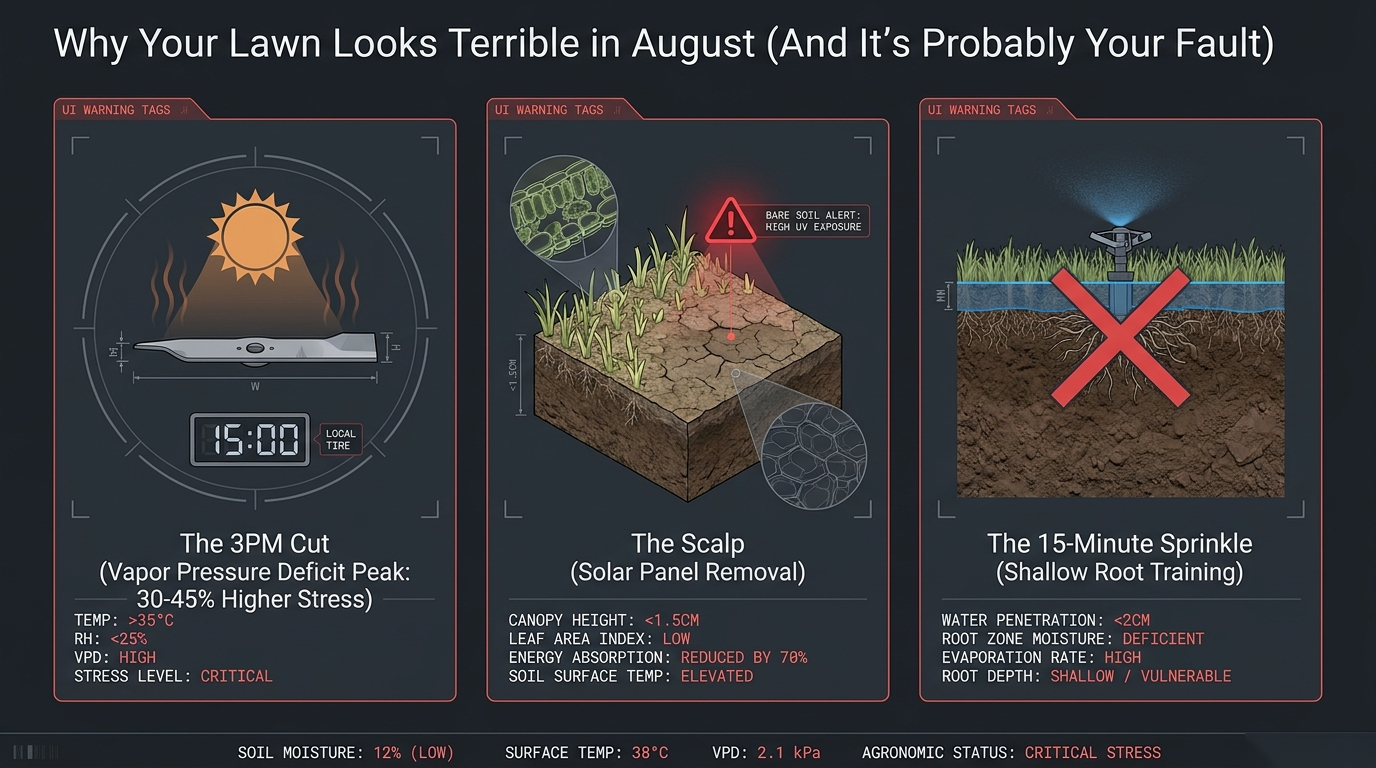
Illinois summers are genuinely difficult for lawns. Kentucky Bluegrass, fescue, and ryegrass — the cool-season grasses that cover most Chicago-area properties — evolved to thrive in temperatures between 60°F and 75°F. When the thermometer climbs past 85°F for weeks at a time, those grasses enter a stress response that makes them vulnerable to every mistake a homeowner can make. And most homeowners make at least three of them.
The frustrating part is that none of these mistakes are obvious in the moment. You mow. The lawn looks fine. You water. It looks fine. Then it's late August and you're staring at a patchy, thin, brownish lawn wondering what happened — because the damage from June and July doesn't fully show up until the heat has had weeks to accumulate.
Mistake 1: Mowing in peak afternoon heat
When you mow a blade of grass, you create a wound. The plant responds by pushing resources to the cut ends to seal them and prevent water loss — the same way your skin responds to a cut. This process requires water and energy. In the cool of the morning, when temperatures are low and dew has added moisture to the canopy, the plant can handle this without much stress.
At 3pm on a 90°F July day, the conditions are exactly reversed. The plant is already under heat stress. It has already lost significant moisture to transpiration through the day. Its stomates — the tiny pores that manage gas and water exchange — have partially closed to conserve water. When you then mow and open thousands of tiny wounds across the leaf surface, the plant is being asked to heal at the moment it is least able to.
Turfgrass research from University of Illinois Extension consistently shows that mowing cool-season grasses before 10am — when soil temperature is lower and atmospheric vapor pressure deficit is at its minimum — reduces post-mow water stress by 30-45% compared to afternoon mowing. The grass is not just "less hot." Its physiological capacity to recover is genuinely higher earlier in the day.
What to do instead: Mow before 10am when temperatures allow, or wait until after 6pm when heat has broken. If you can only mow on weekends at 2pm, water the lawn thoroughly the evening before — a fully hydrated plant handles the stress significantly better than a dry one. LawnSentinel's DSOA algorithm accounts for this automatically, scheduling mowing at the biologically optimal window and skipping when conditions are unfavorable regardless of what day it is.
Mistake 2: Mowing too short because "it looks neater"
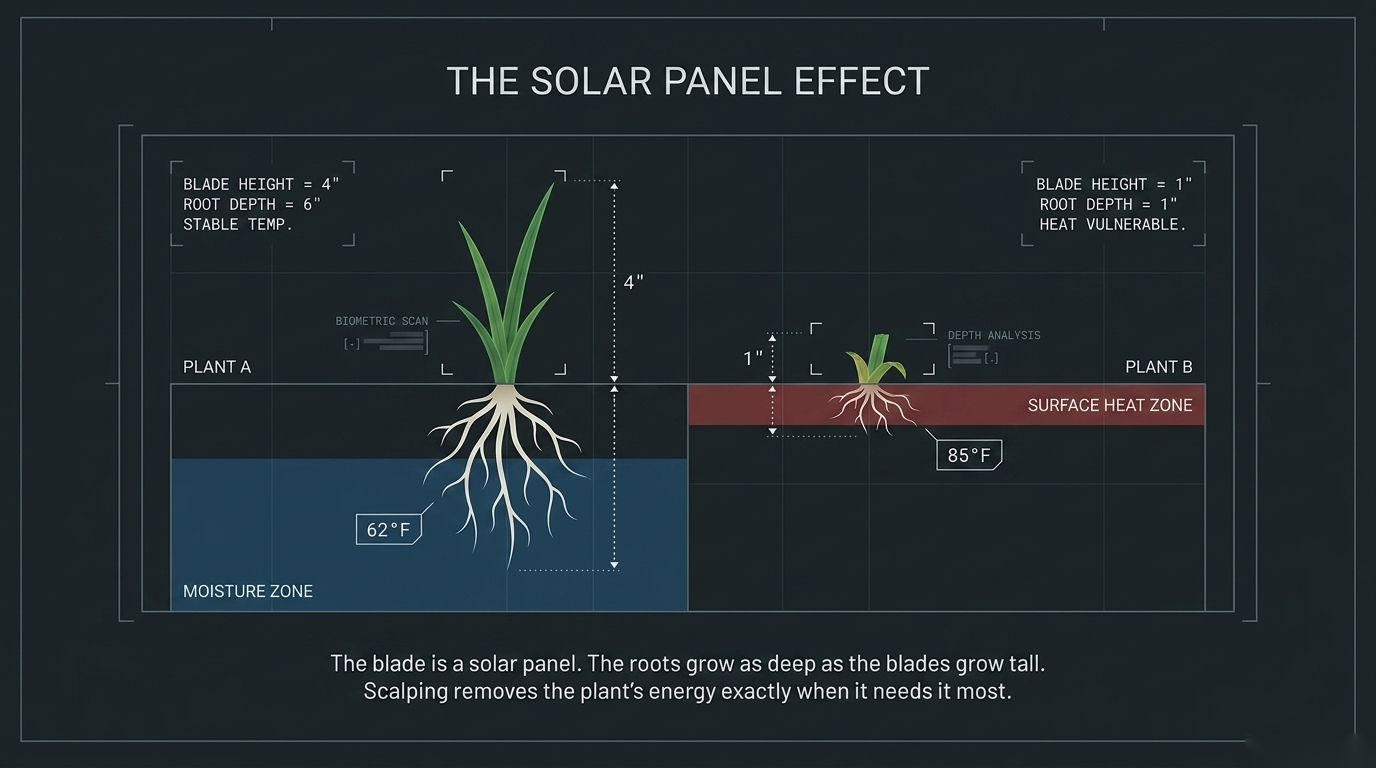
The blade is a solar panel. Roots grow as deep as the blades grow tall.
The blade of a grass plant is not decorative. It is the primary photosynthetic surface — the solar panel that powers the entire root system. When you remove too much of it in a single cut, you are not just making the lawn look short. You are removing a significant portion of the plant's energy-generating capacity at the worst possible time.
"The roots grow as deep as the blades grow tall. Scalp the lawn and you scalp the root system's ambition."
The one-third rule is the most important rule in residential lawn care and the most widely ignored. Never remove more than one-third of the blade length in a single mowing. For Kentucky Bluegrass maintained at 3 inches, this means you should mow when it reaches 4.5 inches — not when it gets to 6 inches and you have to take it down in one pass. For a lawn that has been scalped to 1 inch, the root system is shallow, the plant is exposed to soil temperature extremes, and weed seeds — which need light to germinate — suddenly have a clear path to the surface.
Summer mowing heights by grass type for Illinois:
- Kentucky Bluegrass: 2.5–3.5 inches in summer (raise above normal spring height)
- Tall Fescue: 3–4 inches in summer — this grass handles heat better at higher heights
- Fine Fescue: 2.5–3 inches — prefers shade, raise height in sun-exposed areas
- Perennial Ryegrass: 2–3 inches — most heat-tolerant of the cool-season types
The hidden cost of cutting on a budget
There is a second half to the one-third rule that almost no one talks about: following it correctly means cutting more often, not less. During peak growth, keeping a lawn at its ideal height can require five cuts in a single month, because you can only ever take a third off at a time. Most people cut far less often than that — twice a month on a convenient schedule — to save money or reclaim their weekend. By the time they mow, the grass has grown well past the threshold, and bringing it back to "neat" means scalping half the blade in one pass. The infrequent schedule does not spare the lawn stress. It guarantees it.
Nobody stands in the yard with a ruler deciding the grass has grown exactly one-third today. The schedule is set by the calendar or the invoice, not by the plant. This is one of the clearest advantages of an autonomous approach: LawnSentinel cuts precisely when the lawn crosses the one-third threshold — twice in a slow month, five times in a fast one — at no extra cost per cut. And if cutting frequency is genuinely a burden, the honest fix is not to skip cuts and scalp, but to grow slower grass. LawnSentinel monitors how your specific turf is growing and can recommend whether a dwarf or low-growth seed blend in your overseeding mix would reduce how often the lawn needs mowing at the source. The goal is the best-looking lawn — never fewer cuts at the cost of its health.
Mistake 3: Watering every day for fifteen minutes
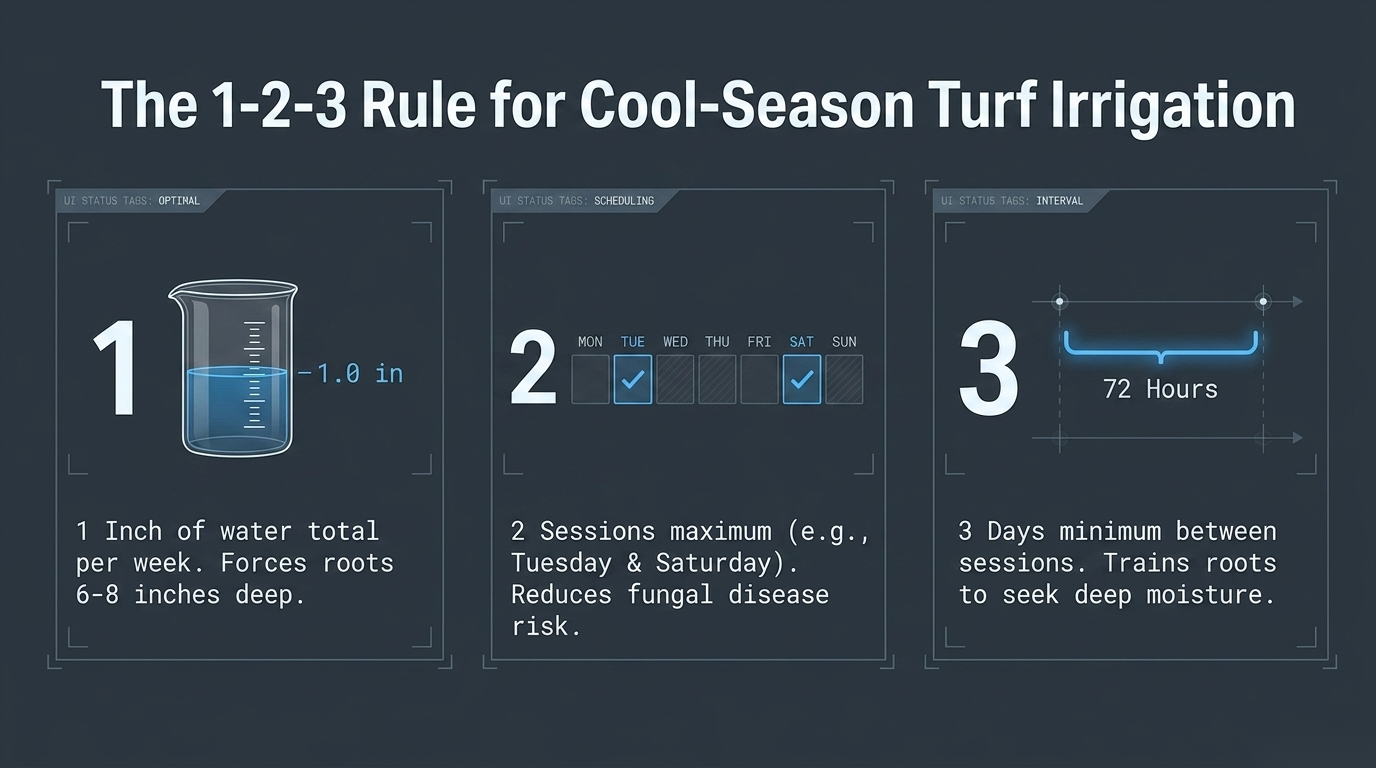
The 1-2-3 rule: one inch per week, two sessions max, three days between.
This one is counterintuitive because it feels responsible. You're watering every day — how can that be wrong? The answer is in how roots grow. Roots grow toward water. If water is always available at the top 2 inches of soil — which is what 15 minutes of daily irrigation delivers — roots have no incentive to grow deep. A shallow root system is vulnerable to heat in a way that deep roots are not, because soil temperature at 6 inches is dramatically more stable than at 1 inch.
The target for cool-season Illinois turf is 1 to 1.5 inches of water per week, delivered in two sessions rather than seven. Deep, infrequent irrigation drives roots down 6 to 8 inches where soil stays cooler and moisture is more stable. During an August heat wave, those deep roots are the difference between a lawn that goes temporarily dormant and one that dies.
1 inch of water per week. 2 sessions maximum (e.g. Tuesday and Saturday). 3 days minimum between sessions. This pattern forces roots deep, reduces fungal disease risk (wet canopy at night invites Pythium and Dollar Spot), and uses 40% less water than daily light watering while producing better results.
The compounding effect
Each of these mistakes is damaging on its own. Together they create a compounding spiral that is difficult to recover from mid-season. Shallow roots from over-watering make the plant more vulnerable to heat stress. Afternoon mowing removes the photosynthetic capacity the plant needs to fight that stress. Short mowing exposes the soil to surface heat that shallow roots cannot escape. By mid-August, the lawn is not just stressed — it is depleted.
The good news is that cool-season grasses have a natural recovery window in September when temperatures drop and the lawn can re-establish. Overseed thin areas between September 1-15, increase mowing height going into fall, and switch to deep infrequent watering for the remaining growing season. Most lawns that look bad in August look reasonable by October if September is handled correctly.
Get the LawnSentinel seasonal lawn calendar
Monthly agronomic guidance for Illinois cool-season turf — what to do, when to do it, and why the biology supports it. Free, no commitment.
No spam. One email per month. Unsubscribe anytime.
What LawnSentinel does differently
Every mistake described above stems from the same root cause: the homeowner is making decisions about the lawn without access to the information the lawn is actively producing. The soil temperature at 2 inches. The evapotranspiration rate today versus yesterday. The vapor pressure deficit that determines whether mowing in the next four hours will cause significant stress. This information exists and is measurable — it has just never been available to homeowners in real time.
LawnSentinel's DSOA algorithm evaluates seven environmental conditions before authorizing a mowing session. It measures soil moisture per zone on every pass and adjusts irrigation recommendations accordingly. It tracks Growing Degree Days to know when the grass has actually grown enough to cut rather than cutting on a schedule. It never mows at 3pm in July unless all conditions say it is safe to do so. The homeowner does not have to know any of this. They just have a lawn that is being cared for the way an agronomist would care for it.