Every weekend across America, 54 million homeowners push, ride, or pay someone to cut their grass. The first generation of robotic mowers took care of the pushing — but left every other problem entirely in your hands. The soil still gets ignored. The weeds still come back. The edges still need trimming. And the $3,000 robot sitting in your backyard still has no way to stop someone from walking off with it.
LawnSentinel is the second generation. It does not just mow. It understands your property — biologically, visually, and physically — and acts on that understanding autonomously. This post is a complete visual walkthrough of everything LawnSentinel does and why every one of those capabilities matters to you as a homeowner.
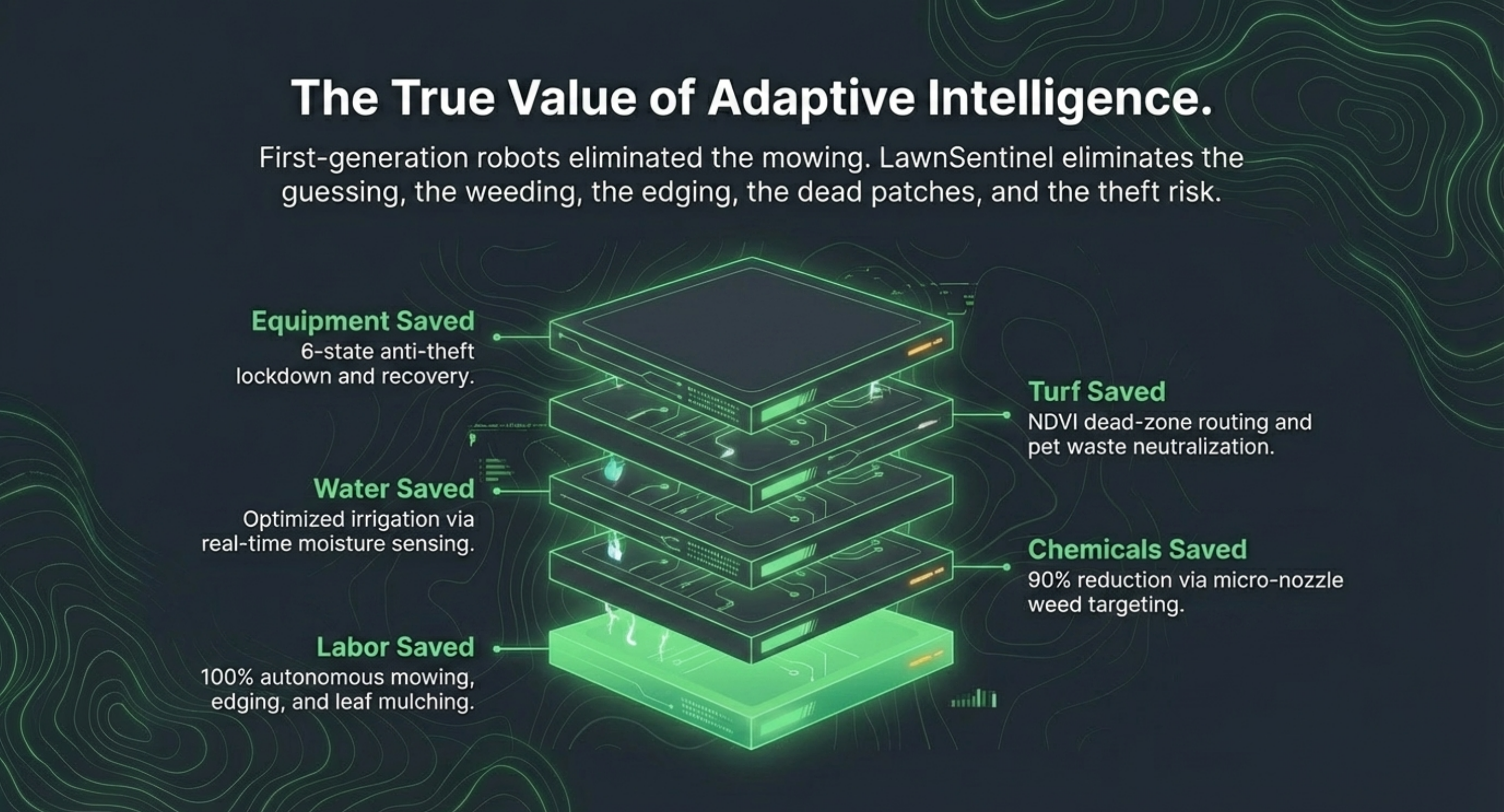
1,600 lbs
CO₂ eliminated per season
VIDEO · LawnSentinel Autonomous Property Intelligence Platform · TerraIQ Inc. 2026
Every Competitor Mows. Only LawnSentinel Understands.
This is not marketing language — it is a factual capability comparison confirmed against every major competitor as of April 2026. Husqvarna. Mammotion. Segway Navimow. Worx. Robomow. None of them offer soil health monitoring, weather-adaptive intelligence, or AI weed detection at any price point. LawnSentinel offers all of it — with 16 Patents protecting every capability.

THE BLUEPRINT OF A LIVING LAWN · Capability comparison across three generations of lawn care
"Every competitor mows. Only LawnSentinel understands."
10 Sensor Systems. One Intelligent Robot.
Intelligence begins with sensing. LawnSentinel integrates ten distinct sensor systems into a single platform — each one working in parallel, each one feeding data into the robot's onboard intelligence layer on every single mowing pass.
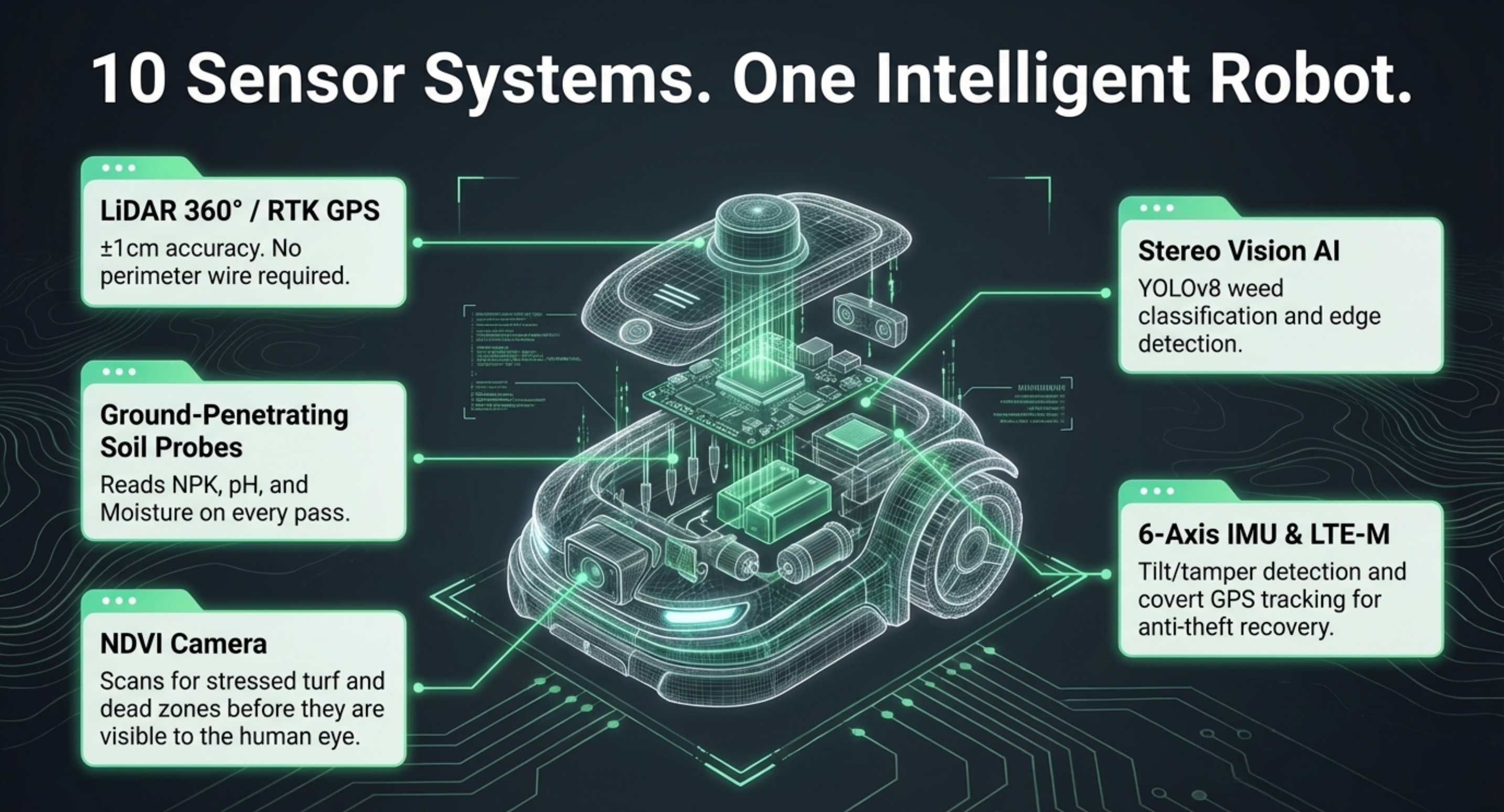
10 SENSOR SYSTEMS · LiDAR · Soil Probes · NDVI Camera · Stereo Vision AI · IMU · LTE-M GPS
- LiDAR 360° + RTK GPS: Centimeter-accurate positioning and full-field navigation — no perimeter wire required on Pro, Elite, and Commercial tiers.
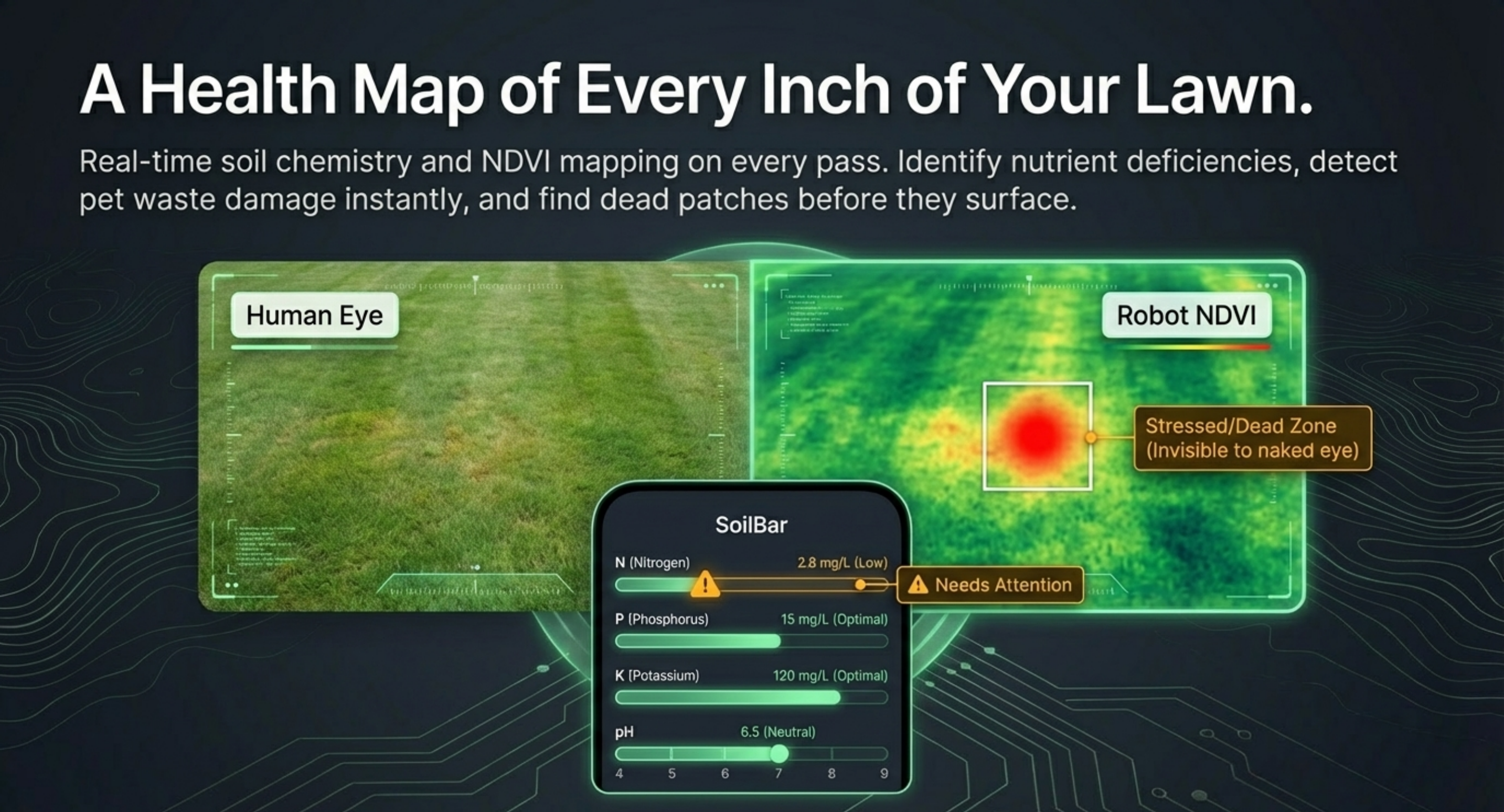
- Ground-penetrating soil probes: Nitrogen, Phosphorus, Potassium, pH, moisture, and electrical conductivity on every pass. Zone-by-zone. Session by session.
- NDVI camera: Near-infrared turf health mapping — detects stressed and dead zones before the human eye can see them.
- Stereo Vision AI (YOLOv8): Identifies 15+ weed species, classifies wildlife by species, and detects boundary types for autonomous edge treatment.
- 6-Axis IMU + LTE-M GPS: Tilt and tamper detection paired with covert GPS tracking that stays active even when the robot appears powered off.
Pillar I — Agronomic Intelligence: Your Lawn's Own Doctor
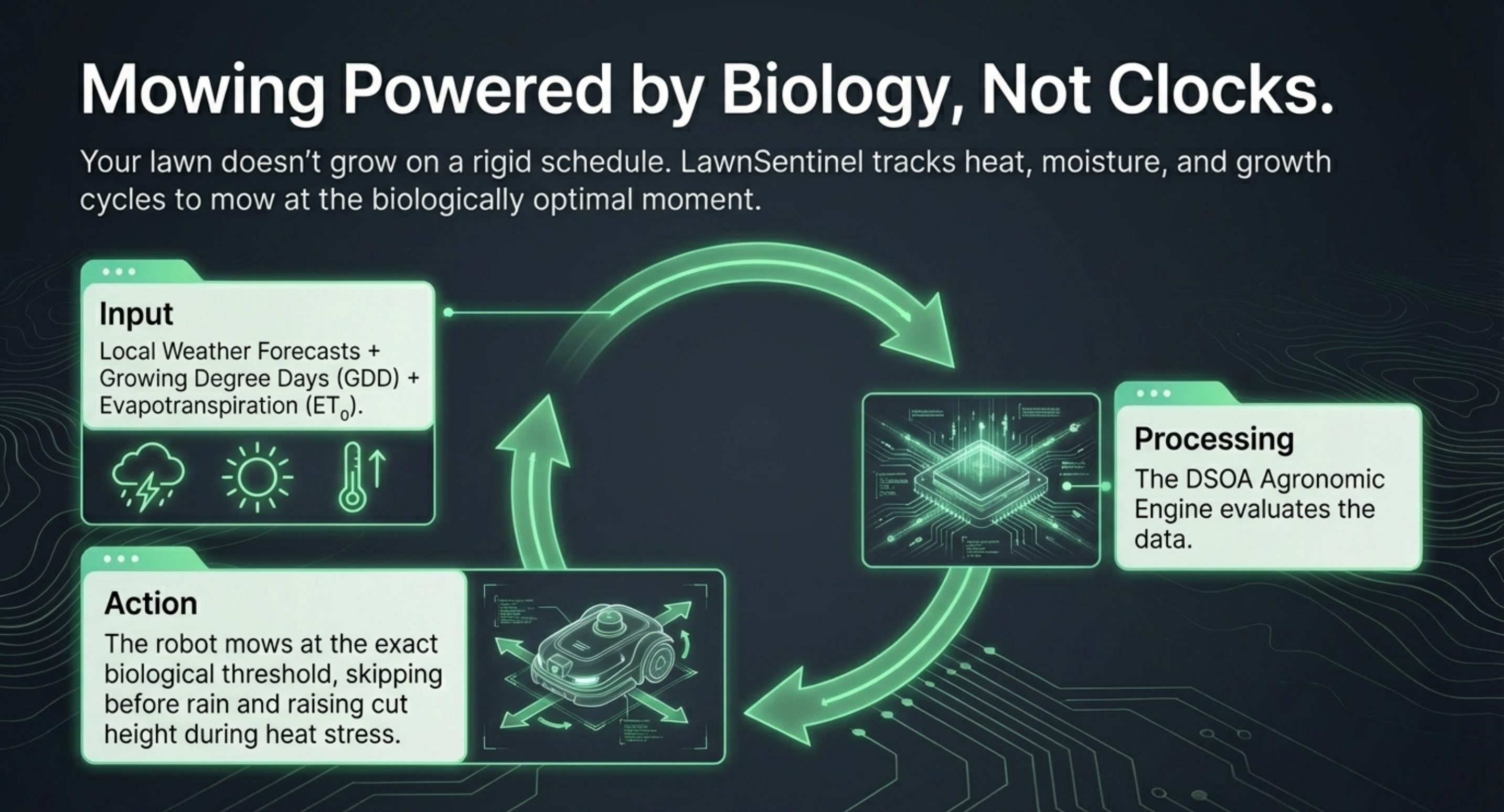
The single most overlooked dimension of lawn care is soil health. Most homeowners fertilize on a schedule that has nothing to do with what the soil actually needs. Overwatering in one zone. Under-fertilizing in another. Mowing at the wrong time of day during heat stress. LawnSentinel eliminates every one of these mistakes through its DSOA (Dynamic Soil and Outdoor Agronomics) decision engine.
PILLAR I: AGRONOMIC INTELLIGENCE · DSOA Decision Engine · GDD · ET₀ · 7-Day Forecasts · Subsurface Soil Sensing
The DSOA engine pulls Growing Degree Day tracking, Evapotranspiration rates, and 7-day weather forecasts into a single algorithm that determines the biologically optimal moment to mow. It skips before rain — preventing soil compaction. It adjusts cut height during heat stress. It mows when your grass actually needs it, not when a calendar says so. Meanwhile the soil probe array is reading NPK, pH, and moisture zone by zone — giving you a complete biological profile of your property every single session.
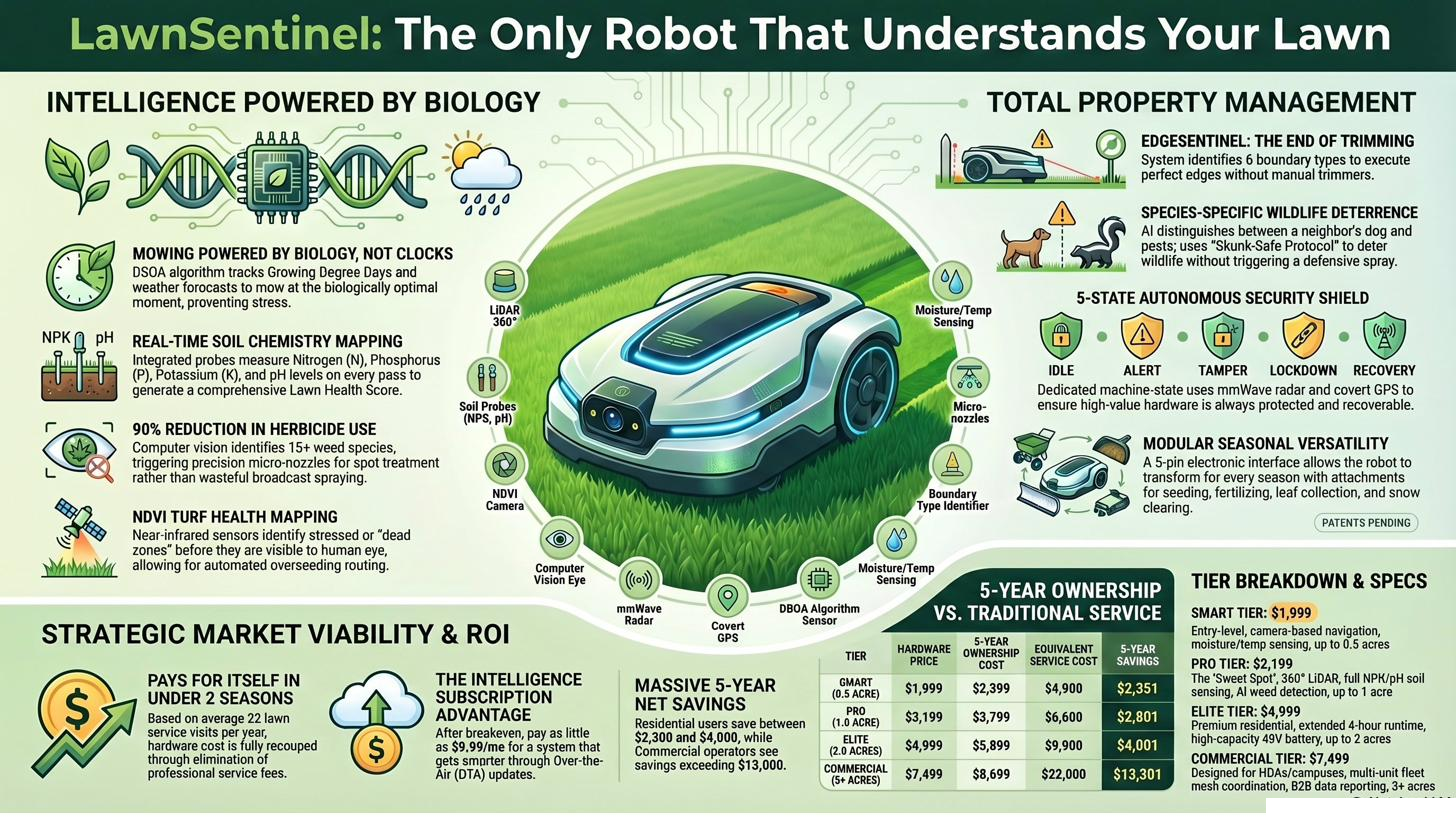
COMPLETE INTELLIGENCE OVERVIEW · All capabilities in a single infographic · TerraIQ Inc.
NDVI Turf Mapping: A Health Map of Every Inch
NDVI — Normalized Difference Vegetation Index — is the same technology agricultural satellites use to monitor farm health from space. LawnSentinel brings it to ground level, generating a color-coded health map of your property on every mowing session. Deep green zones are thriving. Yellow zones are stressed. Red zones are dead or diseased. And the system tells you exactly what to do about each one.
NDVI TURF HEALTH MAPPING · Dead zones and stressed areas detected before the human eye can see them
Dead Patches Don't Stay Dead: Autonomous Overseeding
When the NDVI map identifies a dead zone, LawnSentinel does not just tell you about it — it acts. The system GPS-pins the location, diagnoses the probable cause (drought stress, pet damage, grub activity, disease), and when the Broadcast Seeder attachment is connected, routes directly to the affected area to re-seed exactly those coordinates. Healthy zones are skipped entirely. No wasted seed, no wasted time.
NDVI TO ACTION · Dead zone detection → seeder attachment → GPS-routed precision overseeding
Pillar II — AI Vision: Weeds, Wildlife, and the Skunk-Safe Protocol
LawnSentinel's computer vision system runs on YOLOv8 — the same deep learning architecture used in advanced security cameras and autonomous vehicles. It identifies 15+ weed species with confidence scores above 90%, fires a precision micro-nozzle to treat only the weed, and classifies every animal it encounters by species to determine the appropriate response.
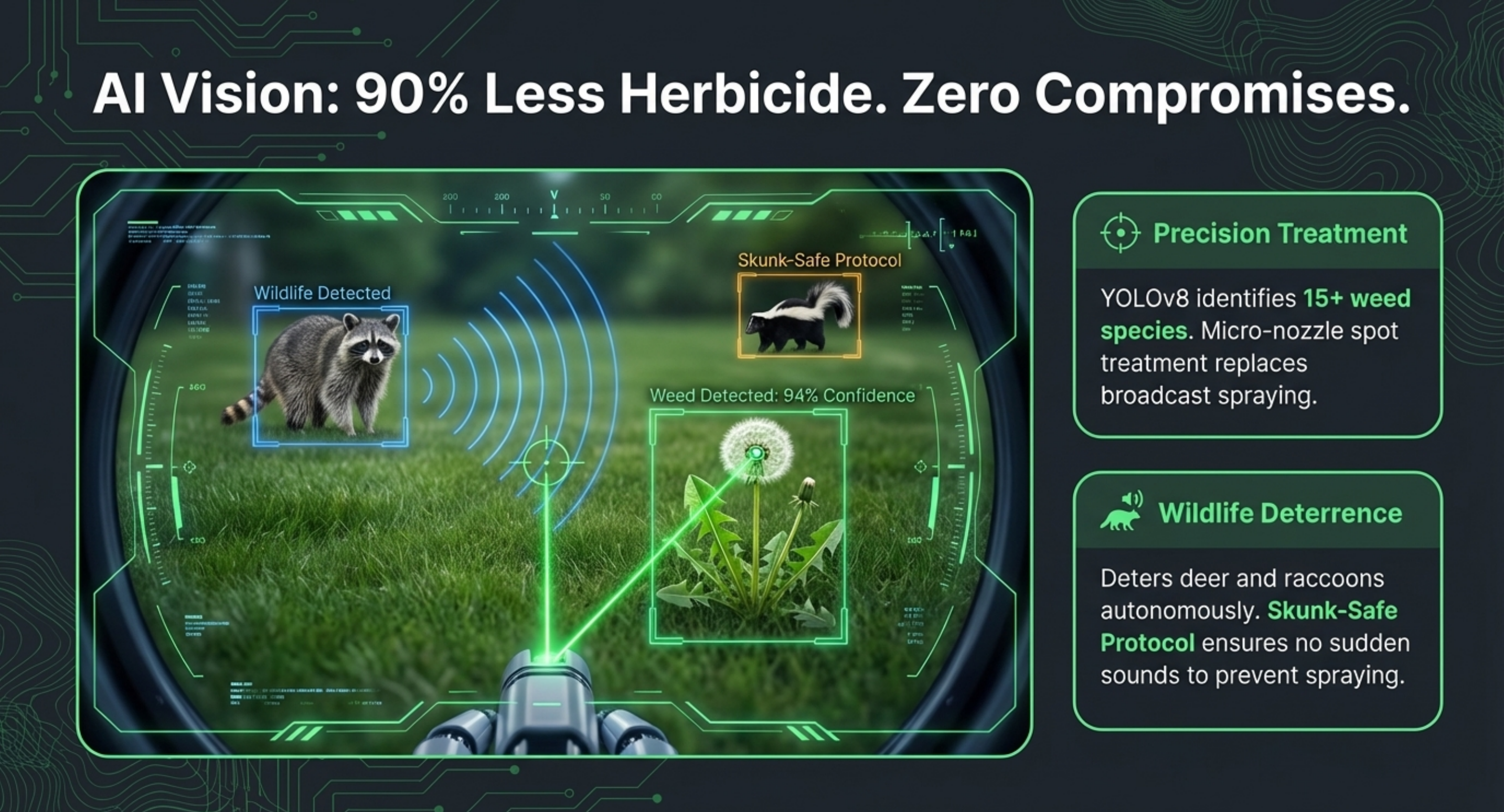
AI VISION: 90% LESS HERBICIDE · Weed detection at 94% confidence · Wildlife species classification · Skunk-Safe Protocol
The Skunk-Safe Protocol is one of our most novel inventions — and it has no prior art anywhere in the USPTO database. When LawnSentinel classifies an approaching animal as a skunk, it immediately suppresses all sudden sounds (which trigger defensive spray) and executes only gradual lighting and low-frequency tonal deterrence. Your robot protects itself from a skunk encounter the same way a wildlife expert would: slowly, quietly, and without escalation. This is covered under Patent Pending PROV-010.
"YOLOv8 identifies the weed, fires a micro-nozzle at 94% confidence, and uses 90% less herbicide than broadcast spraying. Your neighbor's dog gets a gentle nudge. A raccoon gets the alarm."
Pillar III — 6-State Security: A Robot That Protects Itself
You are deploying a $1,999–$7,499 robot outdoors, unattended, for hours at a time. No other autonomous outdoor robot takes security seriously enough to build it into the hardware architecture. LawnSentinel's 6-State Security Machine is a patent-pending system that operates completely without cloud dependency — meaning it works even when your WiFi goes down.
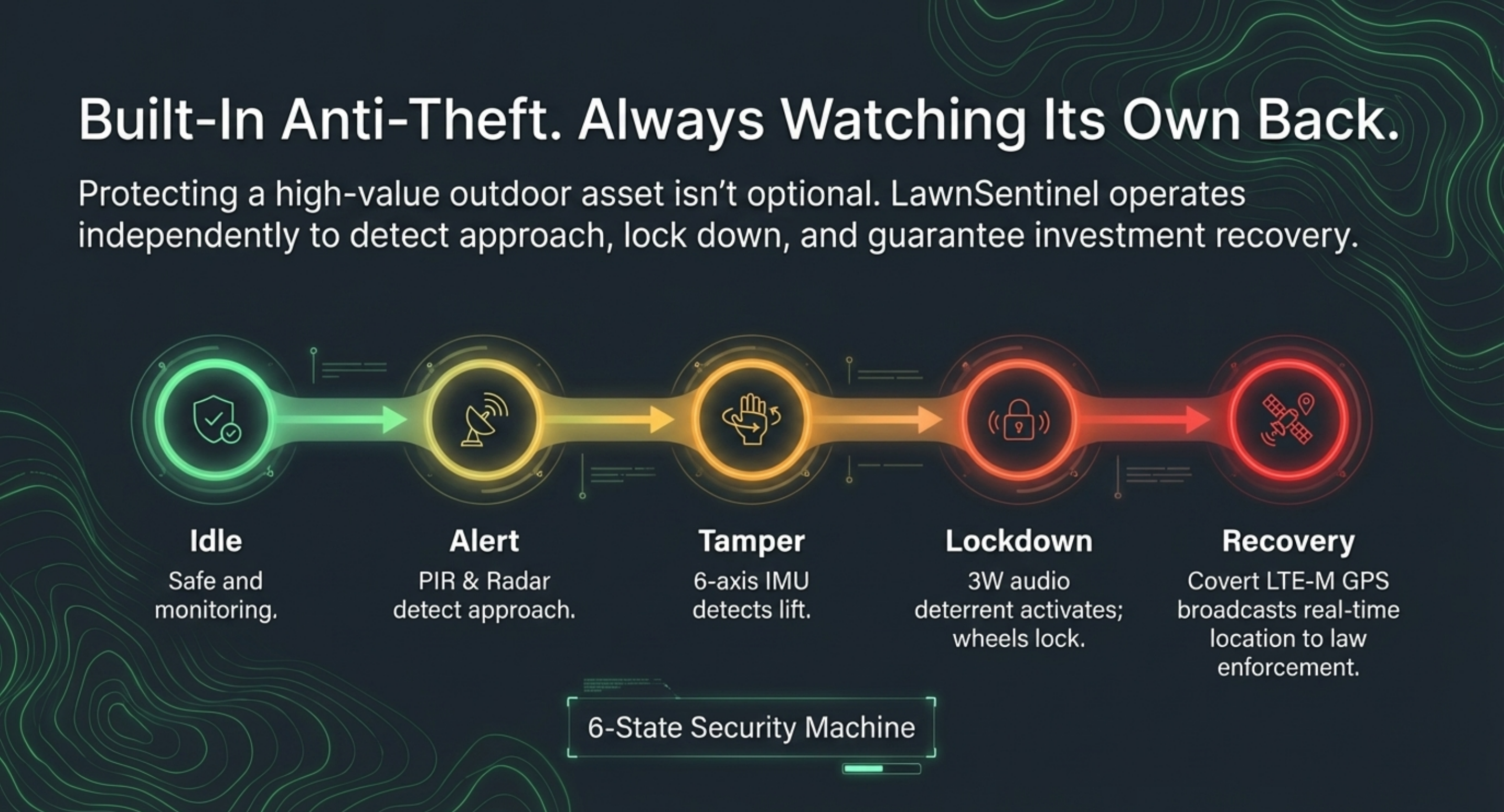
PILLAR III: 6-STATE SECURITY MACHINE · Idle → Alert → Tamper → Lockdown → Emergency → Recovery
- State 1 — Idle: Robot is safe. PIR and radar monitoring active in background.
- State 2 — Alert: PIR or radar detects approach. Unit enters heightened monitoring.
- State 3 — Tamper: 6-axis IMU detects unauthorized lift or tilt. Audio deterrent activates.
- State 4 — Lockdown: Blades disabled. 3W siren active. GPS broadcast begins.
- State 5 — Emergency: Full alert. Real-time location broadcast to owner's phone.
- State 6 — Recovery: Law enforcement liaison mode. Location logged every 30 seconds.

THE FUTURE OF INTELLIGENT LAWN MANAGEMENT · Three pillars: Agronomic Intelligence · AI Weed Eradication · Active Security
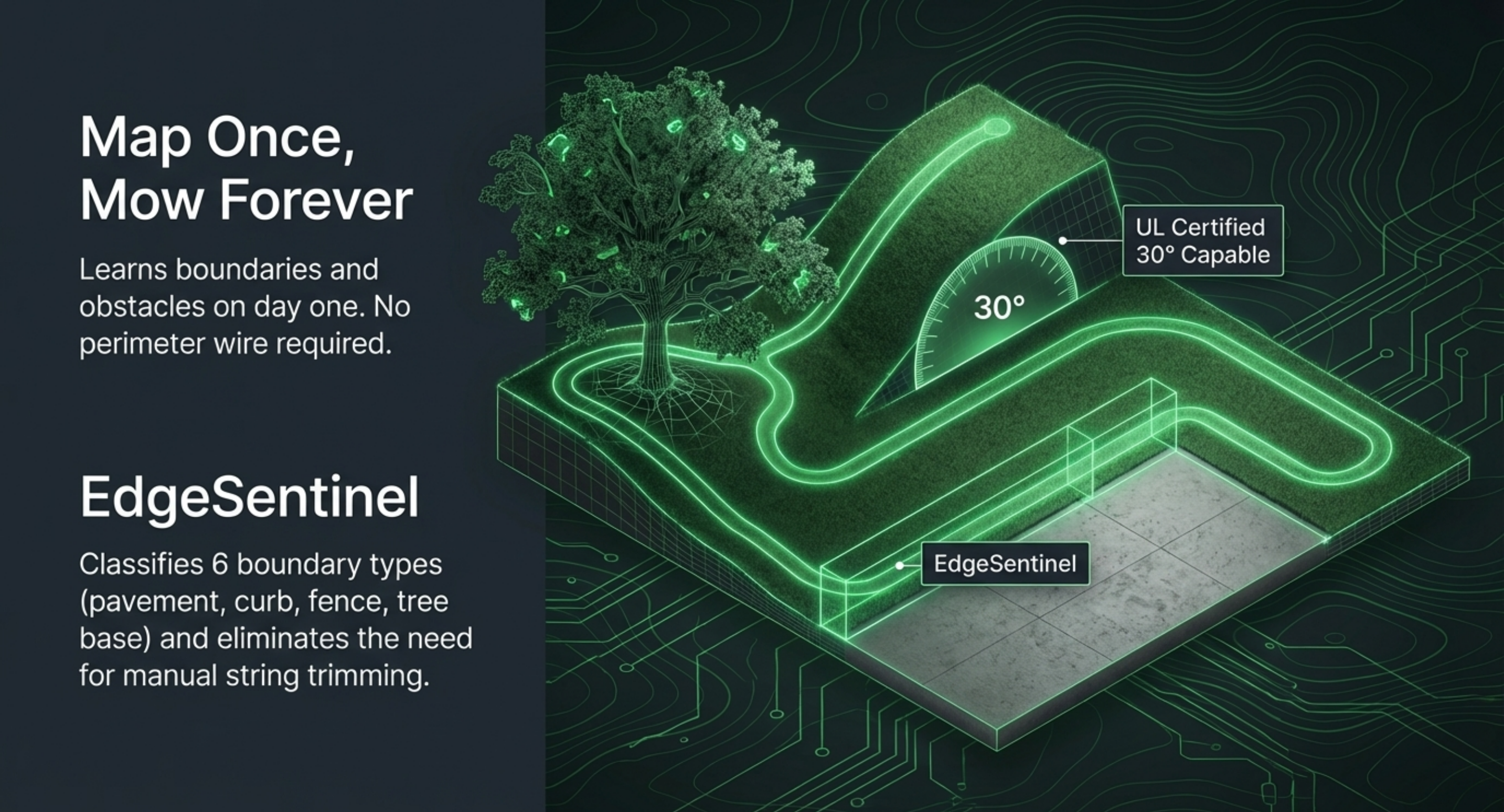
EdgeSentinel: The Last Manual Task — Solved
Every homeowner who owns a robotic mower still picks up a string trimmer to finish the job. The edges along the driveway, fence line, curb, and tree bases — the work that separates a maintained lawn from a perfect one — has never been autonomous. Until now.

EDGESENTINEL · Autonomous boundary classification · 6 boundary types · No trimmer. Ever again.
EdgeSentinel (Patent Pending PROV-009, filed April 3, 2026) classifies six vegetation boundary types and executes the appropriate treatment for each — vertical rotary edging at pavement edges, horizontal string-trim action at fence lines, orbital trimming around tree bases. The prior art search confirmed no competitor has ever filed a patent on boundary classification with adaptive treatment methodology. This lane is ours.
One Platform. Six Tools. Every Season.
LawnSentinel's modular attachment platform uses a quick-release 5-pin electronic interface with auto-detection. Snap in a different attachment and the robot automatically reconfigures its operating mode — no programming required. One investment manages your property across all four seasons.
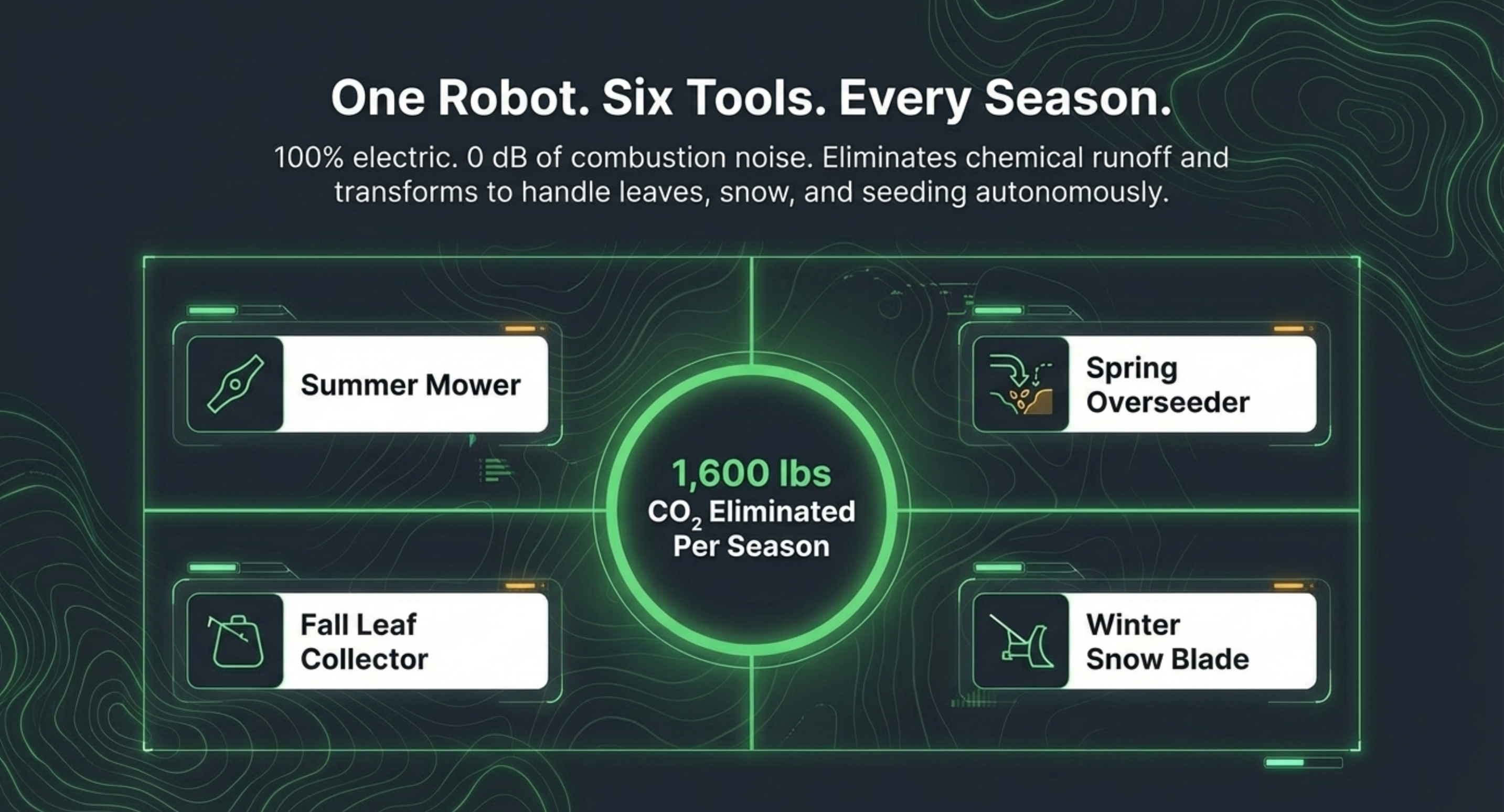
ONE PLATFORM · SIX TOOLS · EVERY SEASON · Snow · Leaves · Seeding · Dethatching · Fertilizing
Mission Control: Intelligence in Your Pocket
The LawnSentinel app (iOS and Android, launching Month 8–10) is the interface through which every intelligence feature surfaces to you. Soil chemistry reports. NDVI heat maps. Weed detection alerts with species identification. Wildlife events. Anti-theft GPS portal. Fleet dashboard for Commercial operators. Everything your lawn generates — in your pocket, every week.
MISSION CONTROL · Live mowing map · Soil chemistry · Biometric security commands · OTA updates
The ROI: Breakeven in Under Two Seasons
The math is straightforward and the honest answer is that LawnSentinel Pro pays for itself faster than most homeowners expect. Based on 22 lawn service visits per season at $45 per visit — and assigning $0 value to soil monitoring, weed control, NDVI mapping, and edge treatment (all of which you would pay extra for from a professional service) — LawnSentinel Pro reaches breakeven in approximately 24 months.
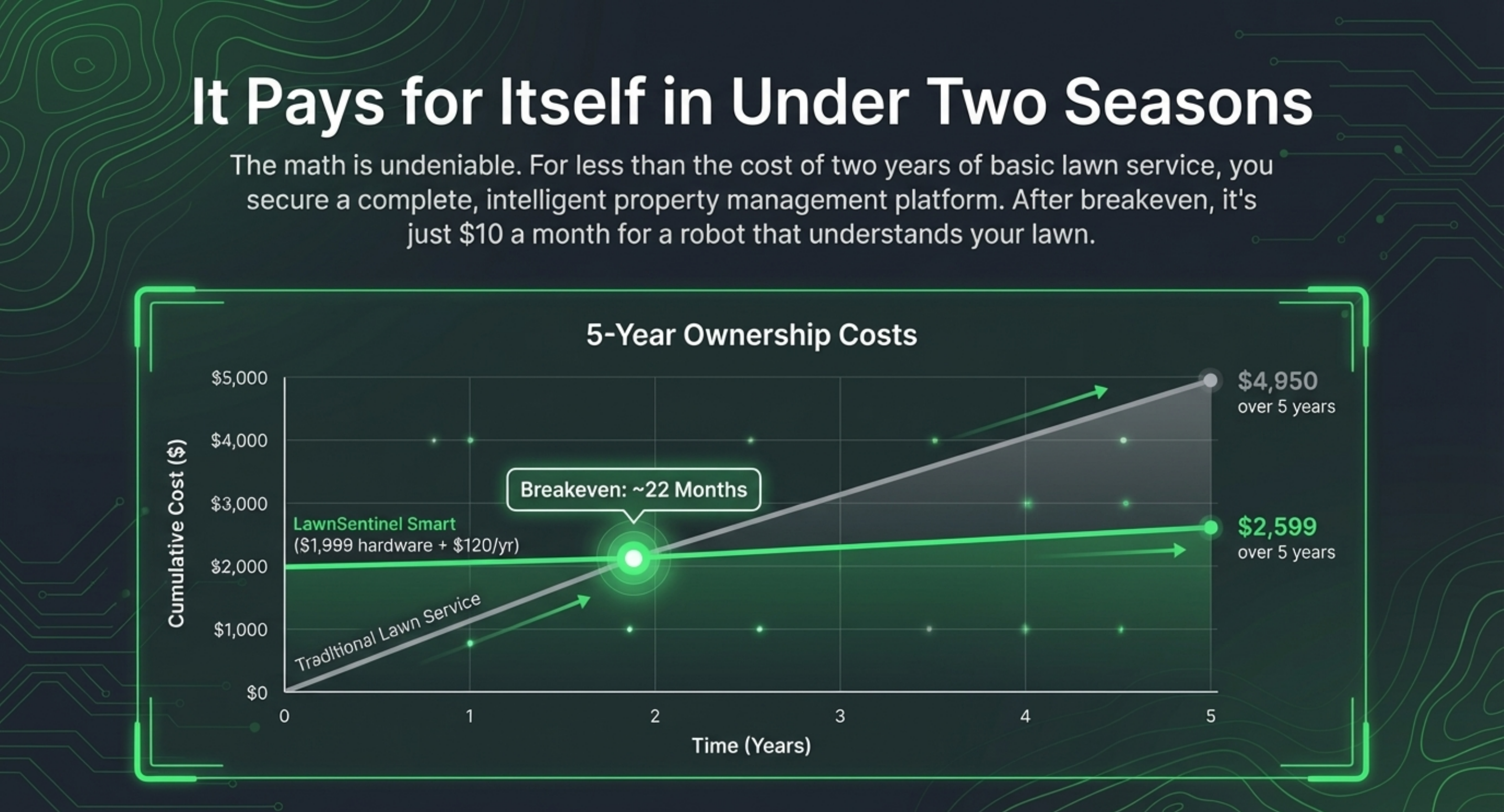
THE ROI · Breakeven in ~24 months · $2,801 saved over 5 years · Pro tier ($3,199 hardware)
After breakeven, your only cost is the Intelligence Subscription — $9.99/month for Smart and Pro, $14.99 for Elite, $19.99 for Commercial. That is the cost of a streaming service, for a robot that understands your lawn at a biological level.
Get LawnSentinel updates in your inbox.
Beta units ship to Cook County, Illinois first. Join the early access list — no payment, no obligation.
Choose Your Intelligence Tier
LawnSentinel launches with four tiers. Pro, Elite, and Commercial units begin beta delivery to Cook County, Illinois early adopters in Year 2. Smart tier launches Year 3. All tiers include the LawnSentinel app and OTA software updates — your robot gets smarter every month you own it.
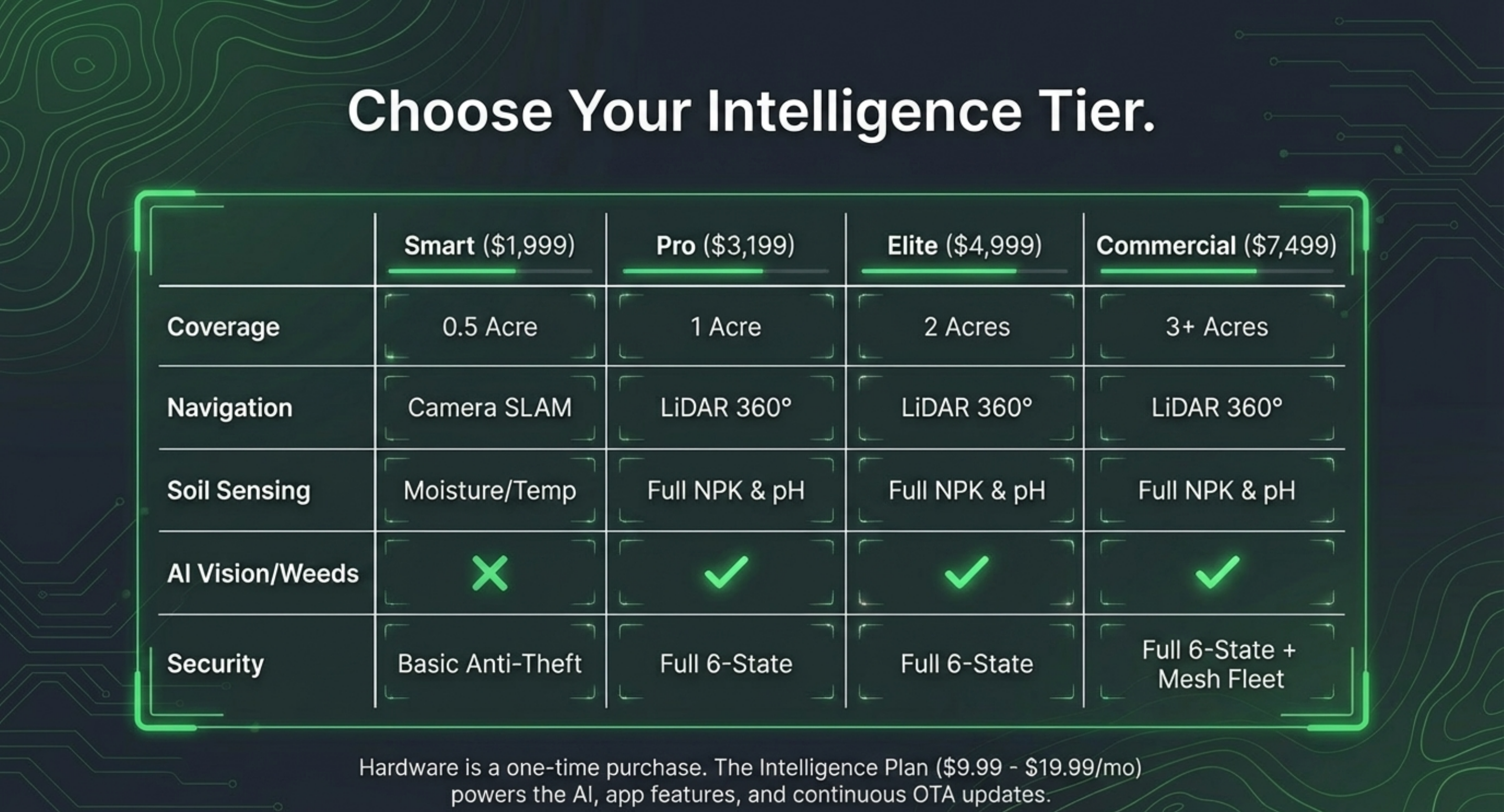
CHOOSE YOUR INTELLIGENCE TIER · Smart $1,999 · Pro $3,199 · Elite $4,999 · Commercial $7,499
The Climate Case: Zero Emissions. Zero Noise. Zero Runoff.
LawnSentinel is a climate product that happens to mow your lawn. Every unit deployed eliminates 1,600 lbs of CO₂ per season compared to a standard gas mower. The electric drivetrain generates zero combustion noise — LawnSentinel can operate at 5am without waking your neighbors. The solar-capable autonomous docking station enables completely off-grid operation in high-solar regions. And precision weed treatment uses 90% less herbicide, dramatically reducing the chemical runoff that contaminates groundwater and kills pollinators.
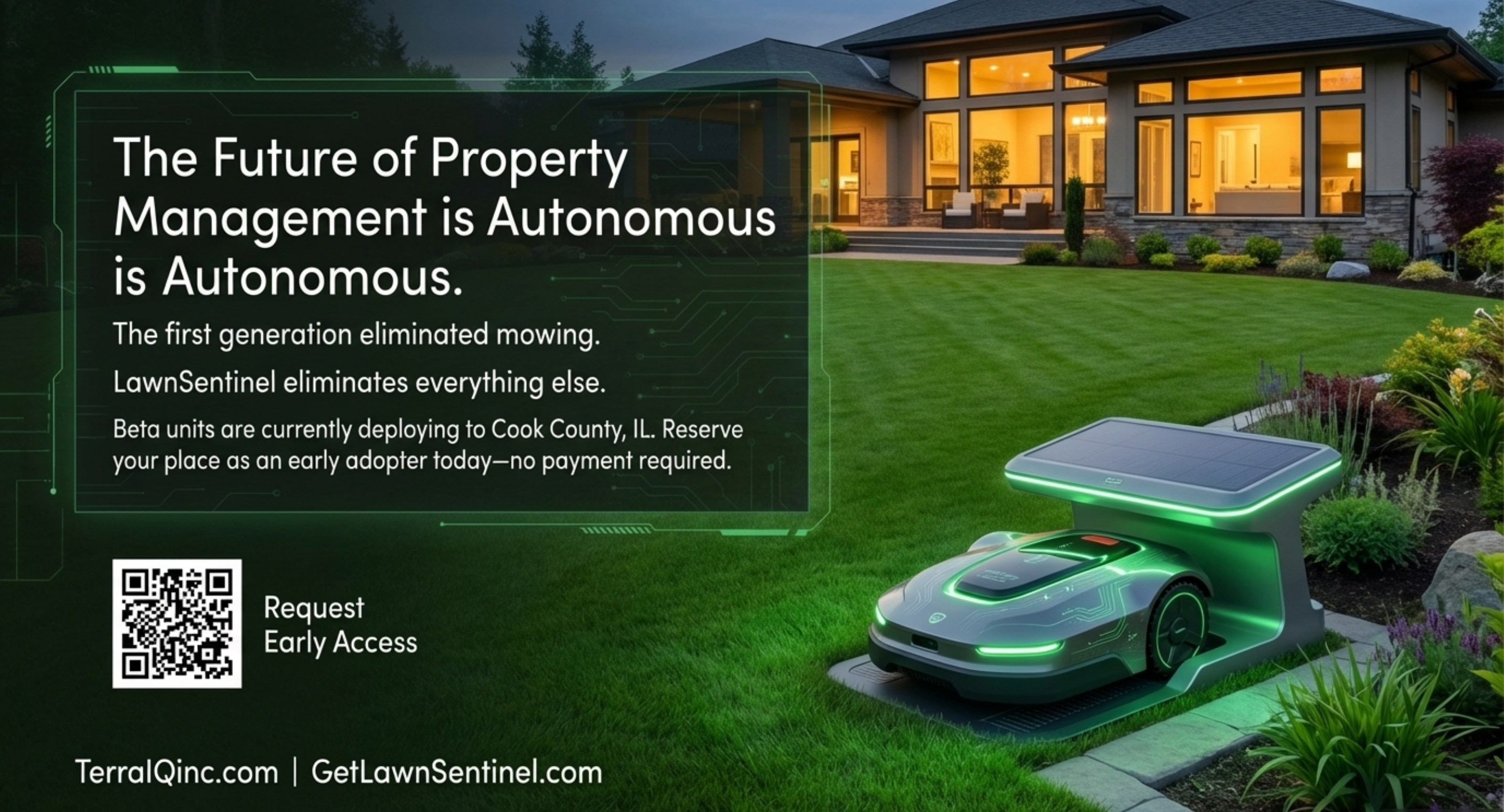
THE FUTURE · Beta units deploying Cook County, IL · GetLawnSentinel.com · Request Early Access
What's Next
TerraIQ Inc. is currently in prototype development. Beta units will be delivered to Cook County, Illinois early adopters first — no payment required to reserve your place. We are also actively pursuing NSF SBIR and USDA SBIR research funding, and are registered with the US federal government as a Minority-Owned Business (SAM.gov) and Black American Owned enterprise.
If you are a homeowner, commercial property operator, or HOA manager in the Chicago metro area — or anywhere in the US — and you believe your property deserves better than a robot that just mows, we want to hear from you.
Be First on the List.
Beta units ship to Cook County, Illinois first. No payment. No obligation. Just your name on the list — and we will reach out when your area opens.
Request Early Access →
GetLawnSentinel.com · TerraIQinc.com · 16 Patents Pending · Built in America
About TerraIQ Inc.
TerraIQ Inc. is a deep technology startup based in Palos Hills, Cook County, Illinois. The company was founded by an engineer with dual degrees in Electrical Engineering and Agricultural Engineering — a combination that directly underpins every design decision in LawnSentinel. TerraIQ has filed 16 provisional patent applications with the USPTO covering robotics, AI navigation, soil health monitoring, security systems, fleet coordination, agricultural mapping, autonomous charging, and wildlife deterrence. The company is a Delaware C-Corporation, registered with the US government as a Minority-Owned Business and Black American Owned enterprise, and is preparing NSF SBIR Phase I and USDA SBIR Phase I applications for non-dilutive federal research funding.
Disclaimer: LawnSentinel is in active development. All specifications, pricing, and availability dates are subject to change. Product renderings are conceptual. 16 provisional patent applications are filed with the USPTO — non-provisional conversion pending. Visit GetLawnSentinel.com for the most current information.