🌱
Spring
Recovery & Growth
☀️
Summer
Peak Stress — Now
🍂
Fall
Overseeding Window
Every summer, the same thing happens. The lawn looks great in May. By mid-July it has brown patches spreading from the edges inward. You water it more. It gets worse. You call a lawn service and they spray something green on it and charge you $180. By September it looks almost normal again and you tell yourself next year will be different.
Next year is not different. Because the problem was never the heat. The problem is that nobody — not you, not the lawn service, not your sprinkler timer — actually knows what is happening in your soil in real time. You are flying blind every summer. And grass dies when you fly blind.
This post is about what is actually happening to your lawn in summer, what your soil is trying to tell you, and why a timer cannot fix a biology problem.
54M
Gas mowers still running in the US
40%
Of residential water used on lawns
50%
Of that water wasted — wrong time, wrong amount
$0
What most homeowners know about their soil moisture right now
The Three Things Summer Actually Does to Your Lawn
Heat alone does not kill grass. Healthy, well-rooted turf can survive temperatures well above 90°F. What summer does is create three compounding stressors that stack on each other — and when all three hit at once, even healthy turf cannot recover fast enough.
Stressor One — Evapotranspiration Demand Exceeds Supply
Evapotranspiration — ET₀ in agronomic terms — is the combined rate at which water evaporates from soil and transpires through grass blades into the atmosphere. On a hot, dry, windy summer day in the Chicago suburbs, a residential lawn can lose the equivalent of a quarter inch of water to ET₀. In a single day.
Your soil has a finite water reservoir. When ET₀ demand exceeds what the soil holds, grass cannot pull enough water through its roots to maintain cellular pressure in the blade. The blade wilts. If the deficit persists for more than two or three days without replacement, the plant enters stress mode — growth stops, the blade tip browns, and the plant begins pulling water reserves from the crown to protect the root system.
Agronomic Science
What Field Capacity Actually Means
Field capacity is the maximum amount of water soil can hold after free drainage has occurred — typically 24-48 hours after a soaking rain. Sandy soils hold less (10-20% by volume). Clay soils hold more (30-40%) but release it less freely to roots. When soil moisture drops below roughly 50% of field capacity, most cool-season grasses enter stress. Below 30%, you have a dead lawn in waiting. The precise threshold varies by grass species, root depth, and soil composition — and it is different in every zone of your property.
Stressor Two — Soil Compaction Cuts Off the Root System
Most homeowners do not think about compaction until they cannot get a screwdriver into the ground in August. But compaction is a summer amplifier — it takes existing heat stress and makes it catastrophically worse.
When soil compacts — from foot traffic, heavy mowing equipment, or simply the repeated wet-dry-wet-dry cycles of summer — the pore spaces between soil particles collapse. Those pores are where water and air travel. Compacted soil cannot absorb rainfall or irrigation efficiently. Water pools on the surface, runs off, or evaporates before it penetrates to root depth. The grass is sitting on a water-filled soil that its roots cannot access.
Compaction also prevents root extension. A grass plant under heat stress needs deep roots to access cooler, moister soil layers. Compacted soil stops those roots at 2-3 inches. The plant is stranded in the hottest, driest layer of the soil profile exactly when it needs to go deeper.
Stressor Three — You Are Probably Watering Wrong
This is the uncomfortable truth that lawn services do not tell you because their business depends on you not knowing it: most residential watering is either too much, too little, at the wrong time, or in the wrong zones. Sometimes all four at once.
The standard advice — water deeply and infrequently — is correct in principle. But "deeply" means different things in sandy loam versus clay. And "infrequently" depends on ET₀, which varies every single day based on temperature, humidity, wind, and cloud cover. A timer does not know any of this. It runs on Tuesday at 6 AM whether your soil is at 80% field capacity or 20%.
"Watering on a schedule is like eating three meals a day regardless of whether you are hungry or have already eaten. The schedule feels responsible. The biology doesn't care about the schedule."
Overwatering in summer creates its own catastrophe. Saturated soil at high temperatures is the ideal incubation environment for Pythium blight and brown patch fungal disease — two of the most destructive summer turf pathogens. The very act of trying to rescue a stressed lawn with more water can trigger a disease outbreak that does more damage than the drought stress it was meant to prevent.
Get early access to LawnSentinel — launching 2027.
Cook County residents get first delivery. Join the list now — no payment required.
What Your Soil Is Actually Telling You — And Why Nobody Hears It
Your lawn communicates. The problem is the signals are subtle until they are not — and by the time the blades turn blue-gray and footprints stay visible in the turf for more than 30 seconds, the plant has already been in stress for days. You are reading the warning label after the damage is done.
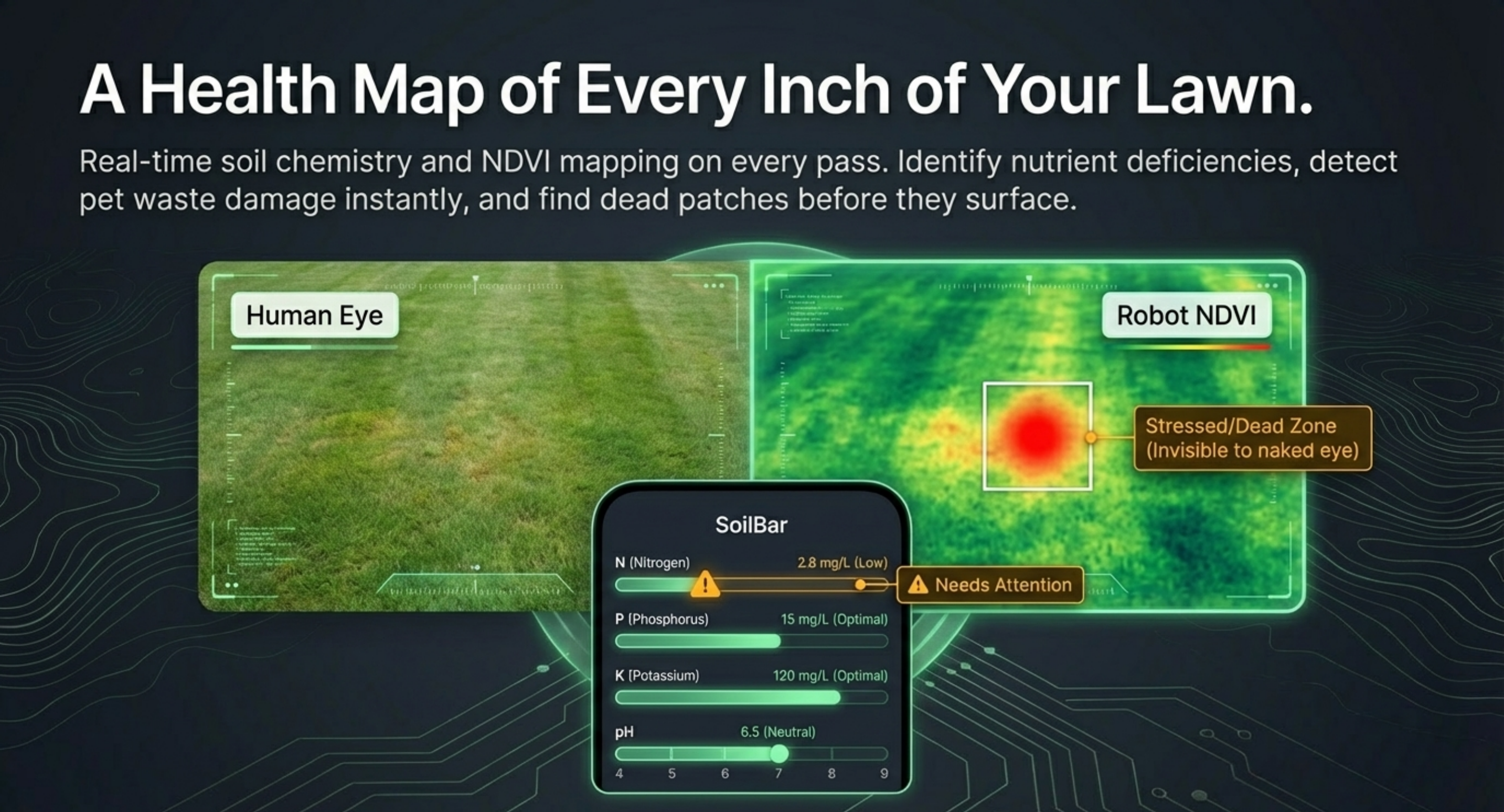
The signals a lawn gives before visible stress are entirely below ground. Soil moisture content dropping. Root zone temperature rising. pH shifting in drought-stressed zones as organic matter mineralizes under heat. Electrical conductivity changes indicating ion concentration from evaporation. These are the early warning signs — and they are invisible to every traditional lawn care system, every sprinkler timer, and every robotic mower on the market today.
The Zone Problem Nobody Talks About
Your lawn is not one thing. It is dozens of micro-environments that happen to be covered by the same species of grass. The south-facing slope by your driveway loses moisture three times faster than the shaded area near your fence line. The clay patch under where the kids play compacts differently than the sandy zone near your foundation. The area where the dog runs repeatedly has different compaction, pH, and nitrogen content than the rest of the lawn.
A single sprinkler head or weather-based irrigation controller treats all of these zones identically. It runs for the same duration, at the same time, at the same rate. The result is that some zones are chronically overwatered while others are chronically underwatered — sometimes within 20 feet of each other on the same property.
| Zone Type |
Moisture Loss Rate |
What a Timer Does |
What the Lawn Needs |
| South-facing slope |
3× average |
Same as everything else |
3× more water, more frequently |
| Shaded fence line |
0.5× average |
Same as everything else |
Half as much — more means disease |
| Compacted traffic area |
Average rate but poor absorption |
Same volume — pools and runs off |
Aeration first, then calibrated water |
| Sandy foundation zone |
2× average, fast drainage |
Same as everything else |
More frequent, lower volume applications |
| Healthy mid-lawn |
Normal |
Same as everything else |
Standard — but only when needed |
This is not a solvable problem with a better timer. It is a data problem. You cannot treat zones correctly without knowing what is happening in each zone in real time.
How Autonomous Soil Intelligence Changes the Equation
LawnSentinel carries a soil chemistry sensor array that takes measurements on every mowing pass — volumetric moisture content, soil temperature, NPK levels, pH, and electrical conductivity — zone by zone across your entire property. Every square foot gets measured, not estimated. Not extrapolated from a weather station three miles away. Measured.
The result is a real-time soil map that updates every time LawnSentinel mows. Your property's south-facing slope shows up as a distinct moisture-deficit zone that is treated differently from the shaded corner. The compacted traffic area shows elevated soil resistance and reduced moisture absorption — flagging it for aeration recommendation before the grass shows visible stress. The sandy zone near your foundation shows faster drainage and triggers more frequent irrigation recommendations at lower volumes.
How LawnSentinel Reads Your Lawn
Six Measurements. Every Pass. Every Zone.
Volumetric Moisture Content (VMC) — the actual percentage of water in the soil by volume, not estimated from weather data. Soil temperature at root depth — the critical driver of heat stress thresholds. NPK concentrations — nitrogen, phosphorus, and potassium availability. Soil pH — which changes under drought stress and affects nutrient uptake. Electrical conductivity — a proxy for biological activity and dissolved ion concentration. Surface temperature — canopy microclimate for heat stress early warning.
The DSOA Algorithm — Biology-Driven Mowing, Not Calendar-Driven
LawnSentinel's Dynamic Scheduling Override Algorithm does not mow on a schedule. It tracks Growing Degree Days — the cumulative heat units that drive actual grass growth — and Evapotranspiration demand, calculated from real-time ambient sensor readings on the robot itself. When ET₀ is high and soil moisture is declining, LawnSentinel reduces mowing frequency automatically. Mowing a drought-stressed lawn accelerates stress — it removes the blade surface area the plant needs for photosynthesis and moisture retention. The right answer in peak summer heat is often to mow less, not more.
This is the opposite of what a timer tells you. A timer mows every Tuesday. Biology does not care that it is Tuesday.
The Irrigation Connection — Closing the Loop
Knowing your soil is dry is only half the solution. Acting on it precisely is the other half. LawnSentinel generates per-zone Water Demand Commands — specifying exactly how much water each zone needs, in liters per square meter, to restore moisture to species-specific field capacity. Those commands are surfaced in the app for manual action, or transmitted automatically to a coupled irrigation system for autonomous execution.
The key distinction from every existing smart irrigation controller is the data source. Rachio, Rain Bird, and Hunter all use atmospheric weather data and static soil type inputs entered at installation. LawnSentinel uses actual measured soil moisture from the ground itself, updated on every mowing pass. Post-irrigation, the next mowing pass confirms whether moisture was restored to target — closing the feedback loop and correcting the next irrigation recommendation based on what the soil actually absorbed, not what the controller assumed it would.
This is the first time residential lawn care has had a closed-loop ground-sensor-driven irrigation intelligence system. It is covered under TerraIQ's provisional patent portfolio — 16 Patents Pending.

What You Can Do Right Now — Before LawnSentinel Ships
LawnSentinel is in development and ships to Cook County early adopters in 2027. Between now and then, here is what actually moves the needle on summer lawn survival based on the same science LawnSentinel automates.
- Water deeply but verify penetration. Push a screwdriver into the soil after watering. It should slide in 6 inches without resistance. If it stops at 2-3 inches, your irrigation is not reaching root depth — run longer, not more often.
- Water before 8 AM. Midday watering loses 30-40% to evaporation before soil absorption. Evening watering leaves blades wet overnight — ideal conditions for fungal disease. Early morning is the only time that makes biological sense.
- Raise your mowing height in July and August. Taller blades shade the soil surface, reducing ground temperature and slowing moisture loss. Never remove more than one-third of the blade height in a single mowing. In peak heat, mow at 3.5-4 inches, not 2.5.
- Do not fertilize during heat stress. Nitrogen drives rapid top growth that demands more water than stressed roots can supply. Hold all fertilizer applications until soil temperature at 4-inch depth drops below 70°F — typically mid-September in northern Illinois.
- Aerate compacted zones before summer peaks. A core aerator rental is $60-80 for an afternoon. Aerating compacted zones in May before summer heat arrives dramatically improves water infiltration through the critical months.
- Accept dormancy as survival, not death. Cool-season grasses like Kentucky Bluegrass and Fescue go dormant in extreme heat as a survival mechanism. A dormant lawn looks brown and dead but is not — it is conserving crown moisture. Do not panic-irrigate a dormant lawn with heavy watering. One inch per week to maintain crown hydration is enough.
"The most expensive thing you can do to a summer-stressed lawn is the wrong thing confidently. A little data goes a long way — and a lot of data changes everything."
The Bottom Line
Summer lawn stress is a soil information problem masquerading as a watering problem. The heat is real. The drought is real. But the reason the same lawn fails in the same spots every July is not bad luck — it is that nobody has been measuring the right things in the right places at the right time.
Timers, lawn services, and first-generation robotic mowers all operate without soil data. They apply uniform treatments to non-uniform biology and wonder why the results are inconsistent. The answer has always been the same: understand your soil first, then act on what it tells you.
That is what LawnSentinel does. On every pass. In every zone. All season long.