Why Golf Courses First
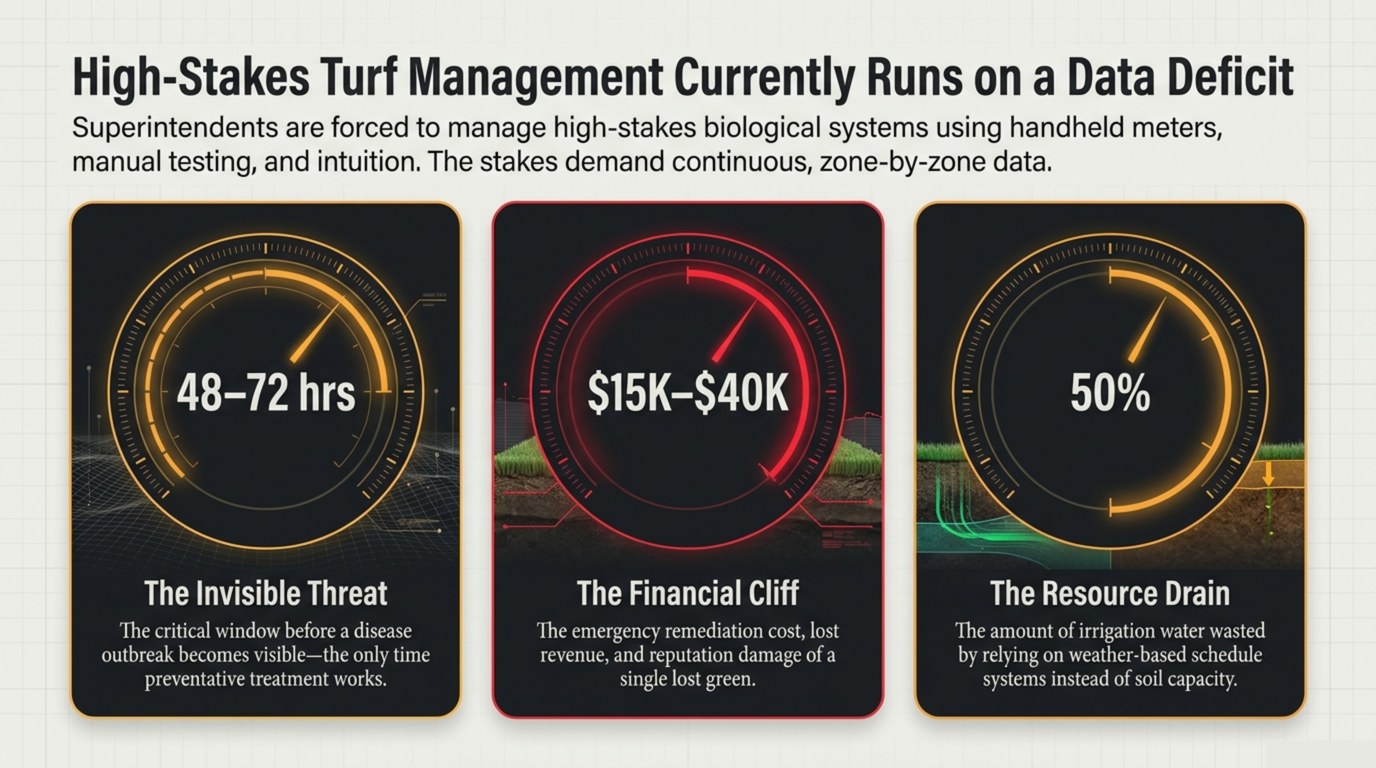
The case for soil intelligence is strongest where the stakes are highest. A residential homeowner loses a lawn patch. A golf course superintendent loses a green — and with it, $15,000-$40,000 in emergency remediation, lost revenue from course closures, and the reputation damage of members playing on compromised surfaces.
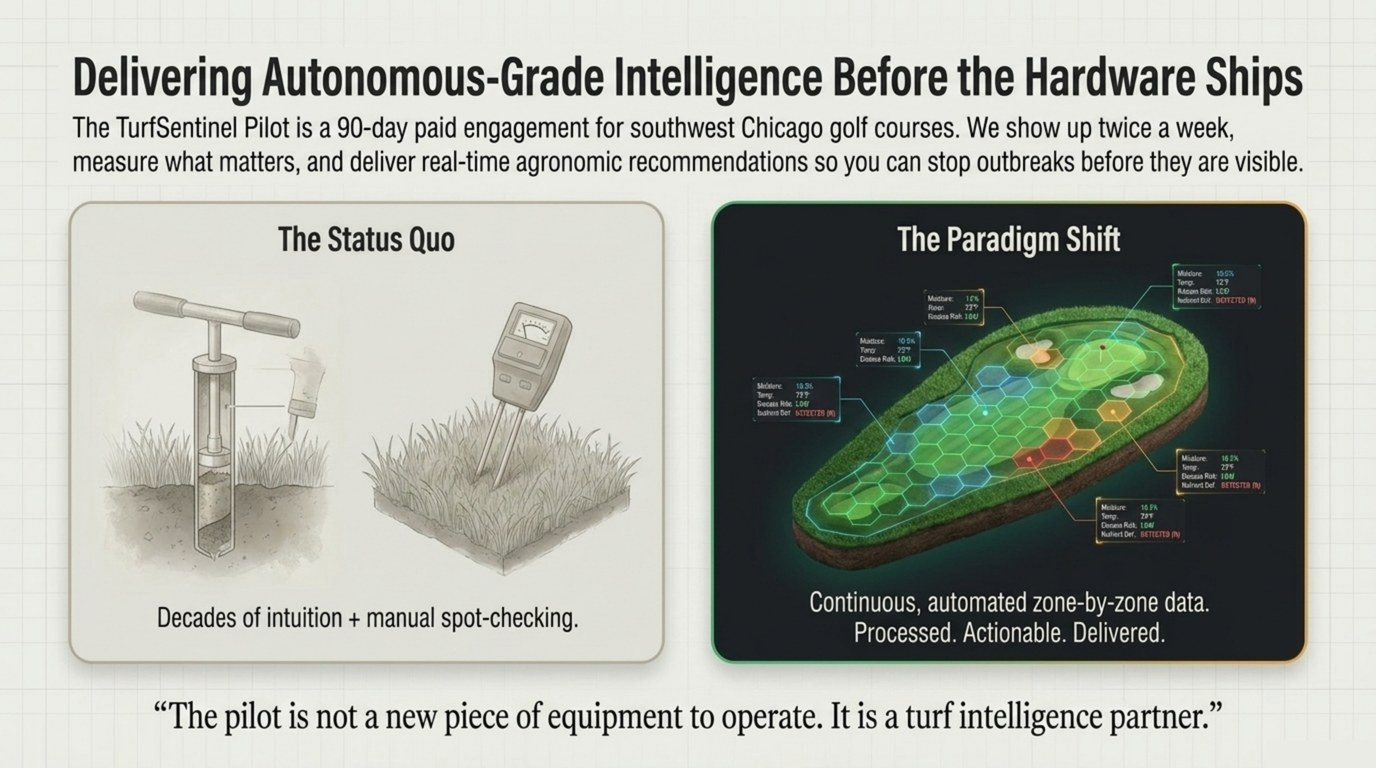
Golf course turf management is also the most data-intensive outdoor surface management work that exists. Superintendents are already tracking soil compaction, moisture, and disease pressure — they just do it with handheld meters, manual testing, and decades of accumulated intuition. What they do not have is continuous, zone-by-zone data delivered to them automatically, processed into actionable recommendations, and updated after every measurement.
That is exactly what TurfSentinel provides. Not a new piece of equipment to operate. Not another dashboard to check manually. A turf intelligence partner who shows up twice a week, measures what matters, and tells them what to do before problems become visible.
"The superintendent's job is to make decisions about a living biological system that changes every day. The problem is they are making those decisions without real-time data. TurfSentinel changes that — before any autonomous hardware arrives."
What the Pilot Actually Delivers
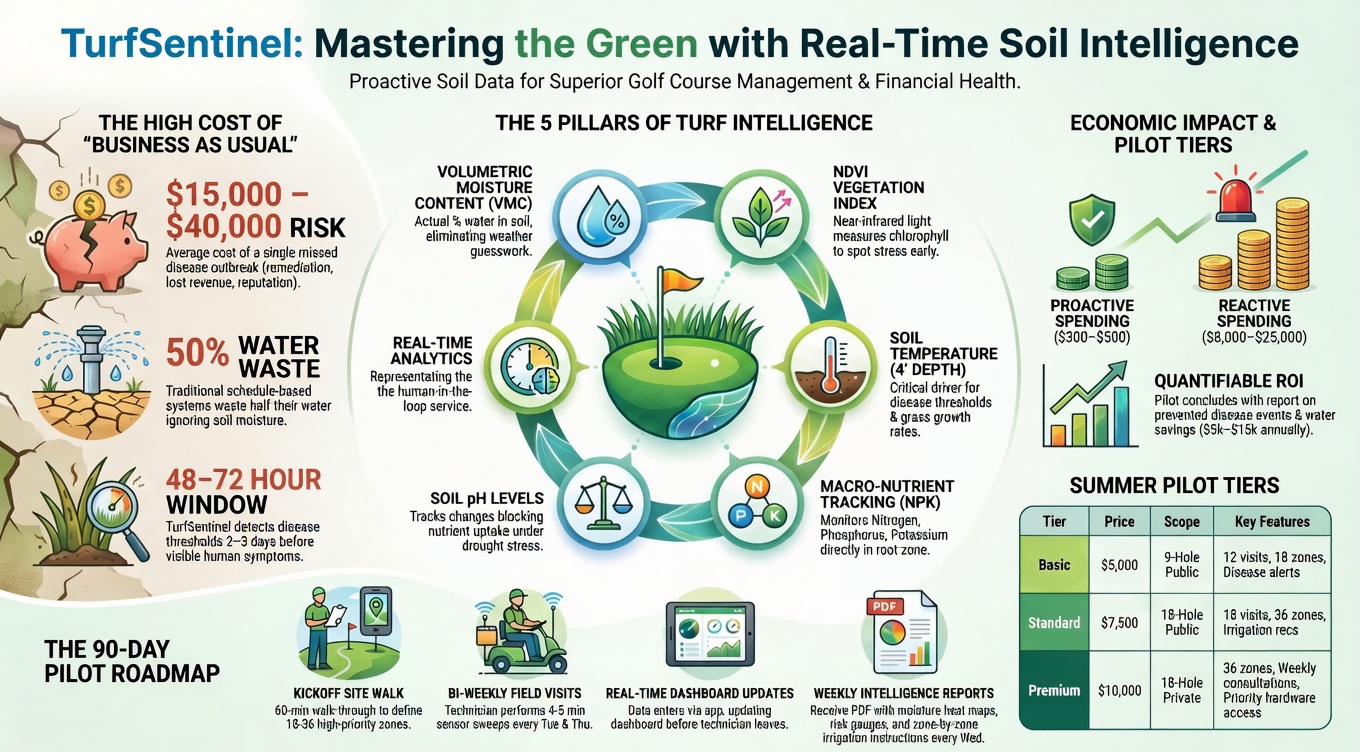
The TurfSentinel Agronomic Intelligence Pilot is a 90-day engagement. Here is exactly what happens:
Kickoff Site Walk
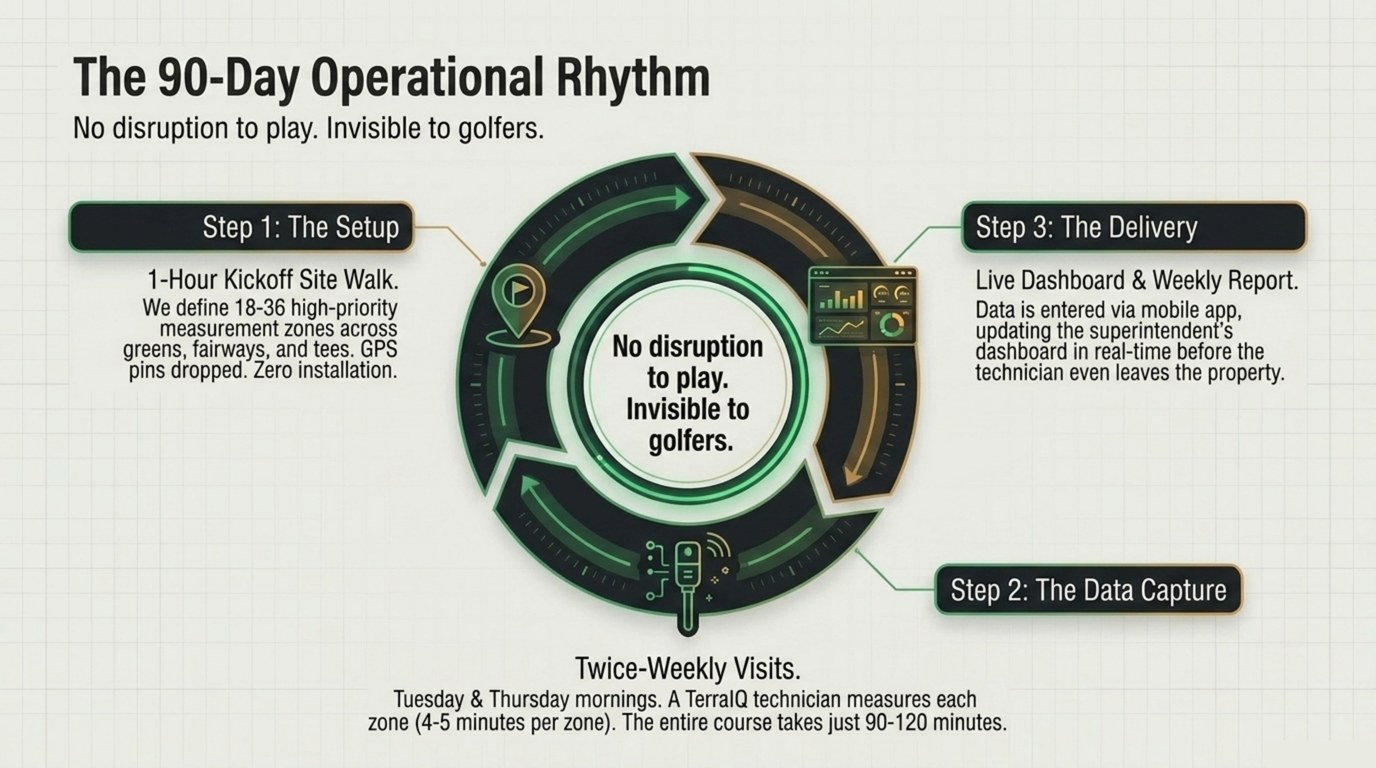
We walk the course together with the superintendent. We define 18-36 measurement zones across greens, fairways, and tees — the areas that matter most to course conditions and playability. GPS pins are dropped at each zone. No installation. No disruption to play. The whole kickoff takes about an hour.
Twice-Weekly On-Site Visits
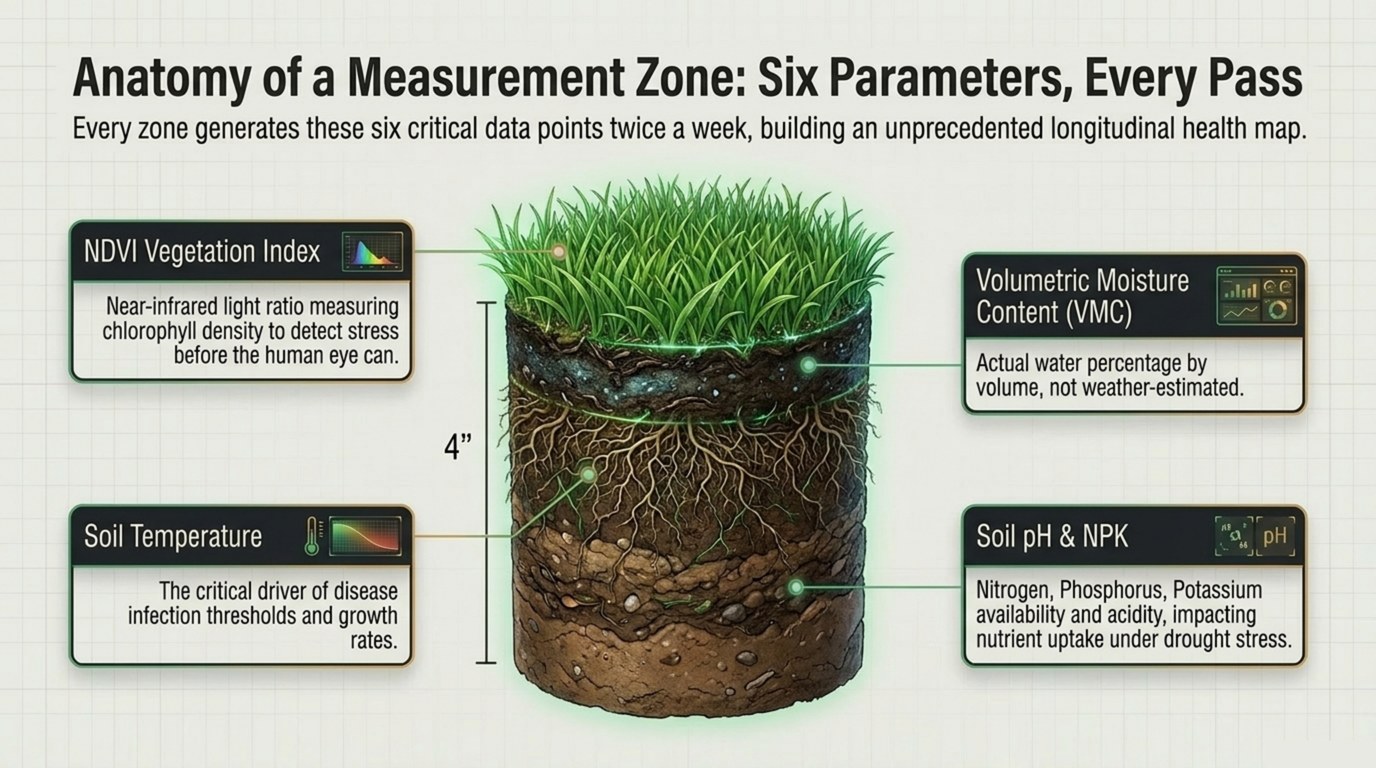
Every Tuesday and Thursday morning, a TerraIQ technician visits the course. At each GPS-pinned zone we measure: soil volumetric moisture content, pH, nitrogen, phosphorus, potassium, soil temperature at root depth, and near-infrared NDVI vegetation health index. Each zone takes 4-5 minutes. The full course visit takes 90-120 minutes.
Live Data Entry — Real-Time Dashboard
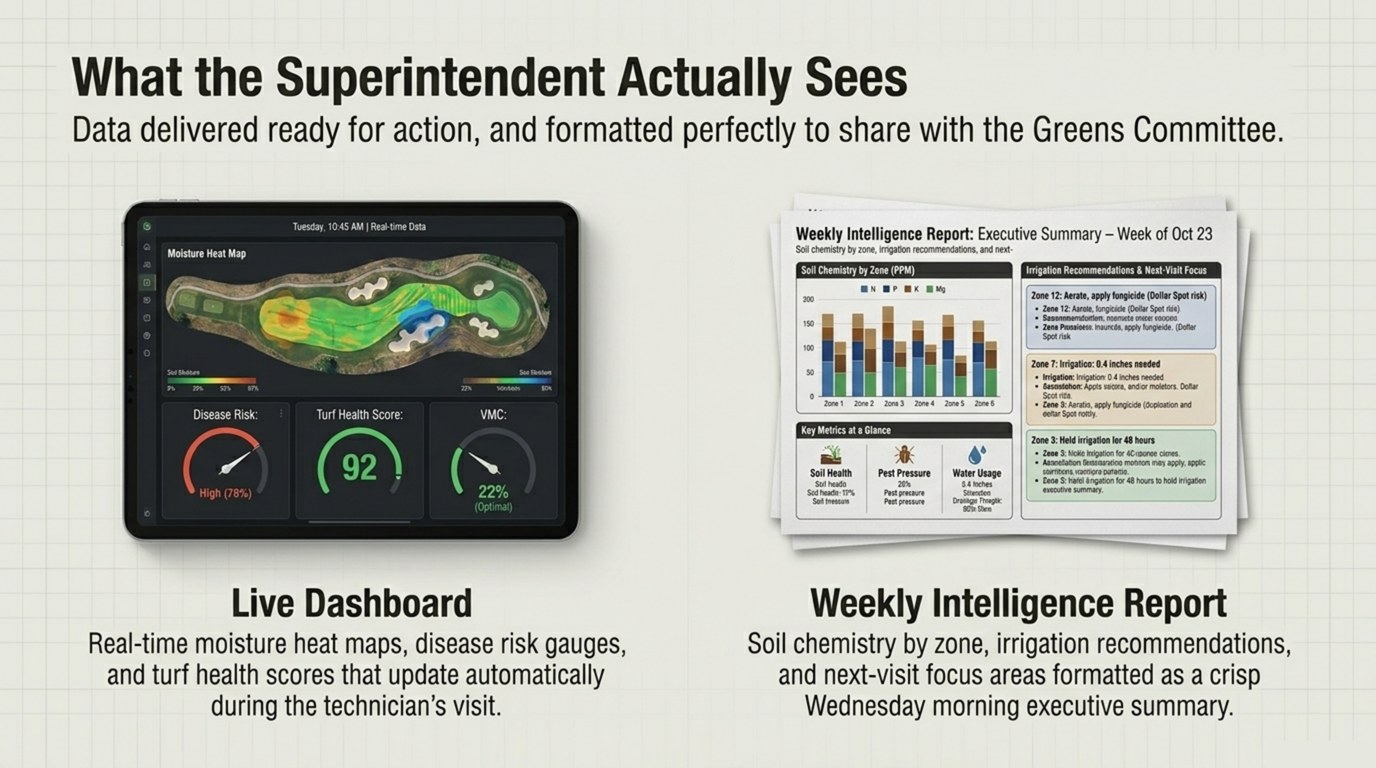
Data is entered via mobile app at each zone as measurements are taken. The superintendent's dashboard updates automatically while the technician is still on-site. By the time the visit ends, the entire course's soil map is current.
Six Parameters. Every Zone. Every Pass.
Volumetric Moisture Content (VMC) — actual percentage of water in soil by volume, not estimated from weather. Soil pH — changes under drought stress and affects nutrient uptake. Nitrogen, Phosphorus, Potassium (NPK) — macro-nutrient availability in the root zone. Soil Temperature at 4-inch depth — the critical driver of disease infection thresholds and grass growth rate. NDVI Vegetation Index — near-infrared light ratio measuring chlorophyll density, detecting stressed turf before the human eye can see it.
Disease Risk Assessment — 48-72 Hours Early Warning
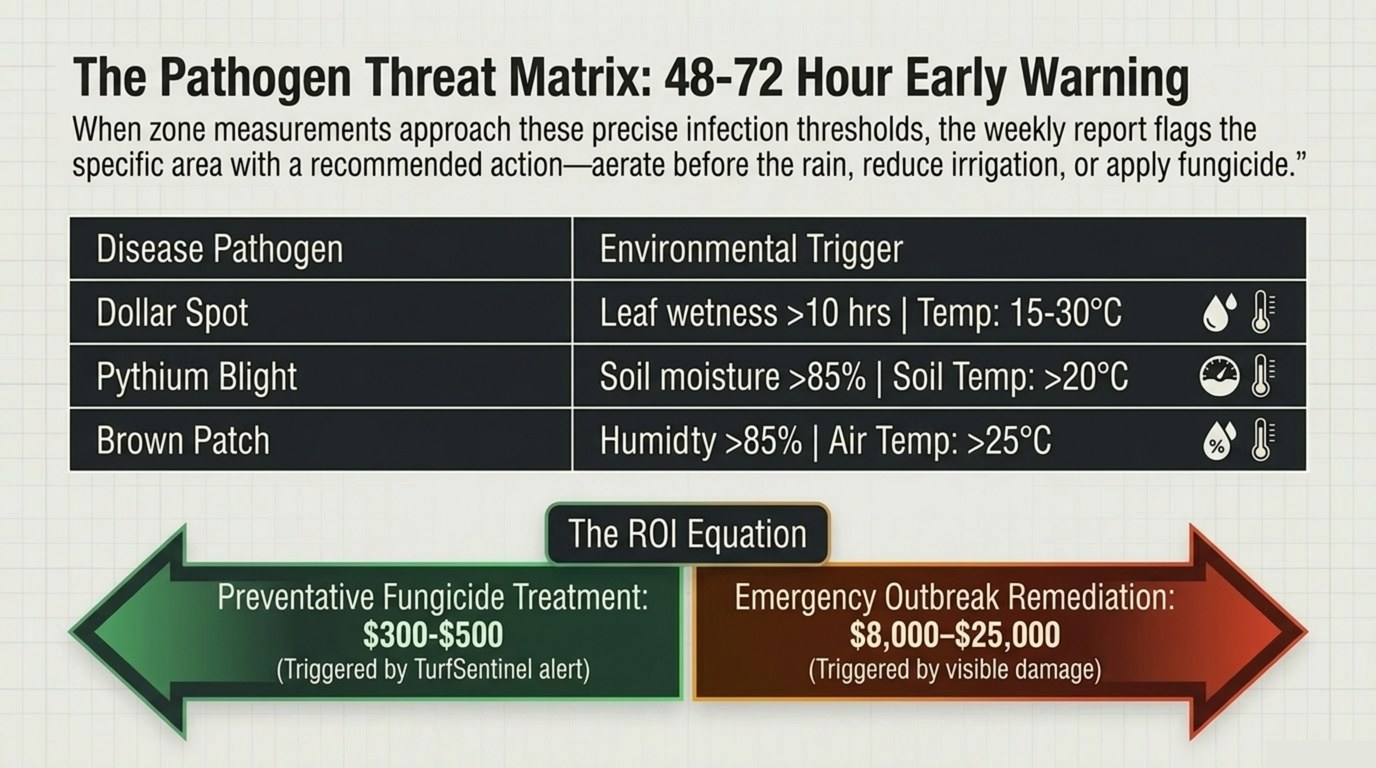
Every major turfgrass pathogen has a documented infection threshold — a specific combination of soil moisture, temperature, and humidity conditions that triggers disease pressure. Dollar spot requires sustained leaf wetness above 10 hours at temperatures between 15-30°C. Pythium blight requires soil moisture above 85% at soil temperatures above 20°C. Brown patch needs humidity above 85% with air temperatures above 25°C.
TurfSentinel tracks these conditions zone by zone. When measurements approach a disease threshold, the weekly report flags it with a specific recommended action — reduce irrigation to this zone, apply preventative fungicide here, aerate that section before the next rain. The preventative treatment costs $300-500. The emergency remediation after outbreak costs $8,000-25,000.
Irrigation Recommendations — Zone by Zone
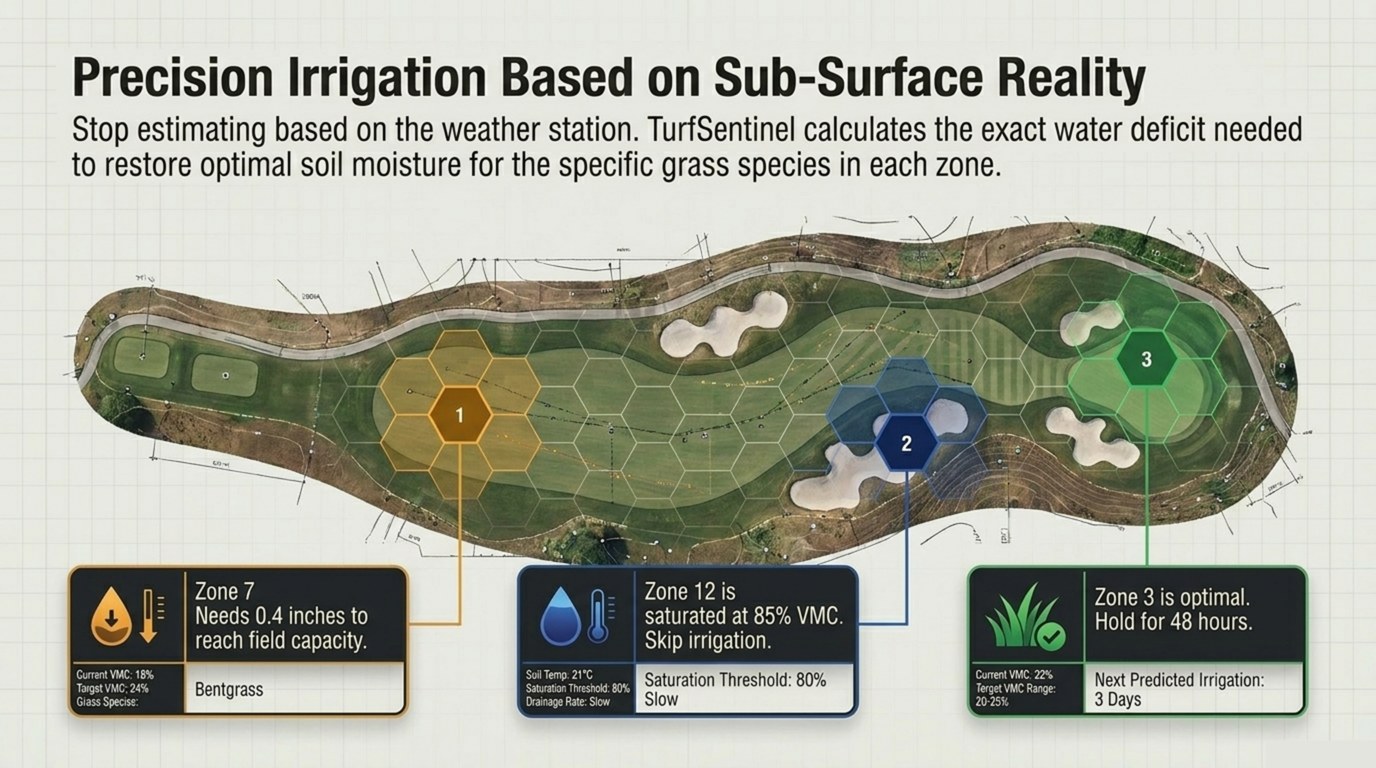
The TurfSentinel system calculates the specific water deficit for each zone — how much water is needed to restore soil moisture to the optimal level for the grass species in that zone. The recommendation is specific: Zone 7 needs 0.4 inches. Zone 12 is already saturated — skip it. Zone 3 can wait 48 hours.
This is not a weather-based estimate. It is a measured soil moisture reading compared against field capacity targets calibrated for the specific grass species in each zone. It is the first time most golf courses will have irrigation recommendations based on what the soil actually contains — not what the weather station thinks it should contain.
Weekly Intelligence Report
Every Wednesday morning the superintendent receives a PDF report and a live dashboard update. The report covers turf health score, soil chemistry by zone, moisture heat map, disease risk gauges, irrigation recommendations, and what the technician will focus on at the next visit. Two pages. Actionable. Ready to share with the club's greens committee if needed.
The Pilot Tiers
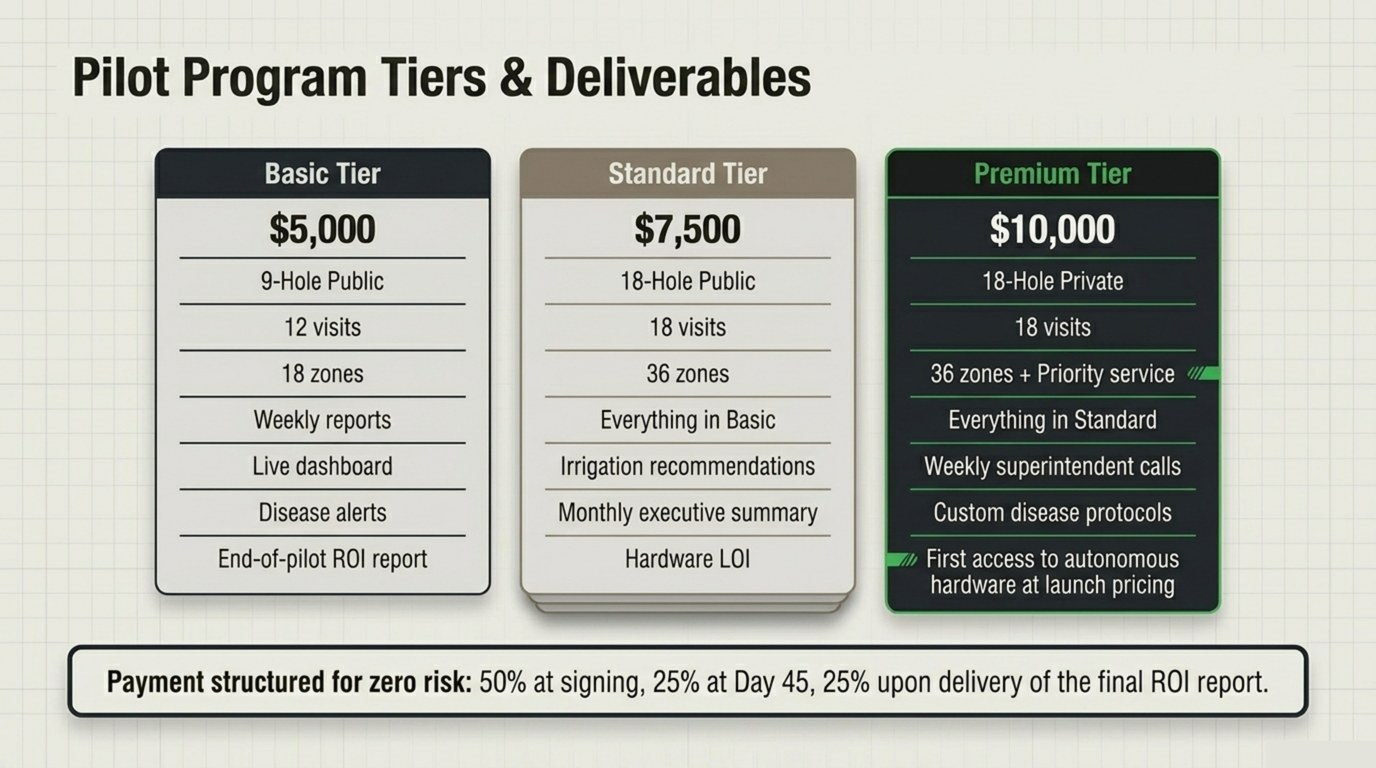
Basic — 9-Hole Public
90-day pilot · 12 visits · 18 measurement zones · 2 zones/hole
- Weekly intelligence reports
- Live dashboard access
- Disease risk alerts (Dollar Spot, Pythium, Brown Patch)
- End-of-pilot ROI report
Standard — 18-Hole Public
90-day pilot · 18 visits · 36 measurement zones · 2 zones/hole
- Everything in Basic
- Precision irrigation recommendations per zone
- Monthly executive summary for Greens Committee
- Hardware Letter of Intent at pilot completion
Premium — 18-Hole Private
90-day pilot · 18 visits · 54 zones · 3 zones/hole
- Everything in Standard
- Weekly phone consultation with superintendent
- Custom disease prevention protocol per pathogen
- First access to autonomous hardware at launch pricing
Premium Plus — Championship Course
90-day pilot · 24 field visits · 72 measurement zones · 4 zones/hole
Designed for courses where a single disease outbreak on a playing surface represents $15,000–$40,000 in remediation, lost revenue, and member relations cost.
Multi-Course & Enterprise
36-Hole, 54-Hole & 72-Hole Properties
Properties with multiple courses receive custom engagement pricing based on acreage, course priority, and visit logistics. Multi-course pilots begin with one flagship 18-hole course and expand by agreement.
Request Enterprise Pricing →Payment structure: 50% at contract signing, 25% at Day 45, 25% at delivery of end-of-pilot ROI report. No payment is due until the contract is signed and the kickoff site walk is scheduled.
Why Only Two Slots This Summer
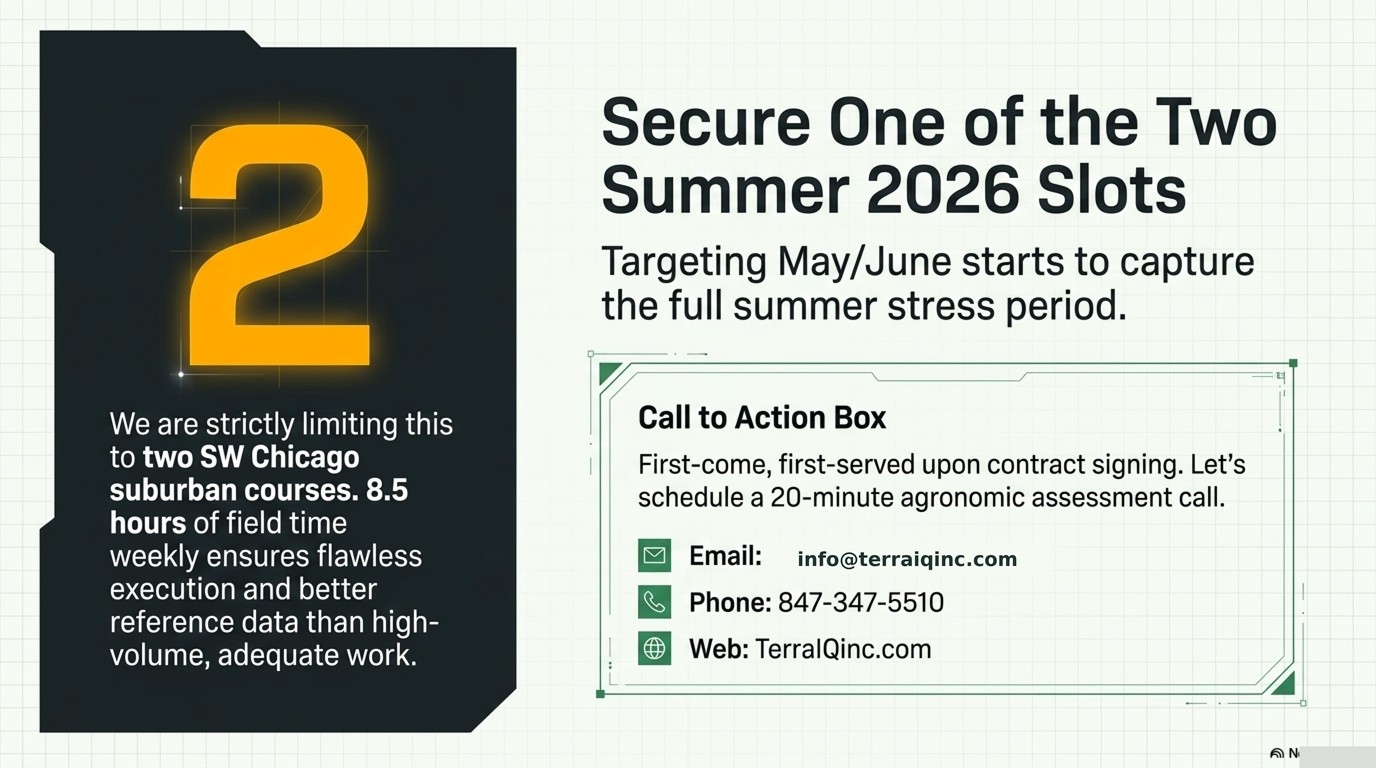
This is not artificial scarcity. Two courses at two visits per week is 8.5 hours of field time weekly — exactly what the summer schedule supports while TerraIQ simultaneously continues hardware development, SBIR grant applications, and patent conversion work. Adding a third course is possible if both courses are geographically close enough to make routing efficient.
The reason for the limit is also strategic. Two courses done excellently produce better data, better testimonials, and stronger Letters of Intent than five courses done adequately. We are building the reference customers that will anchor TurfSentinel's commercial launch in 2027 — not maximizing pilot volume.
What Happens at the End of the Pilot
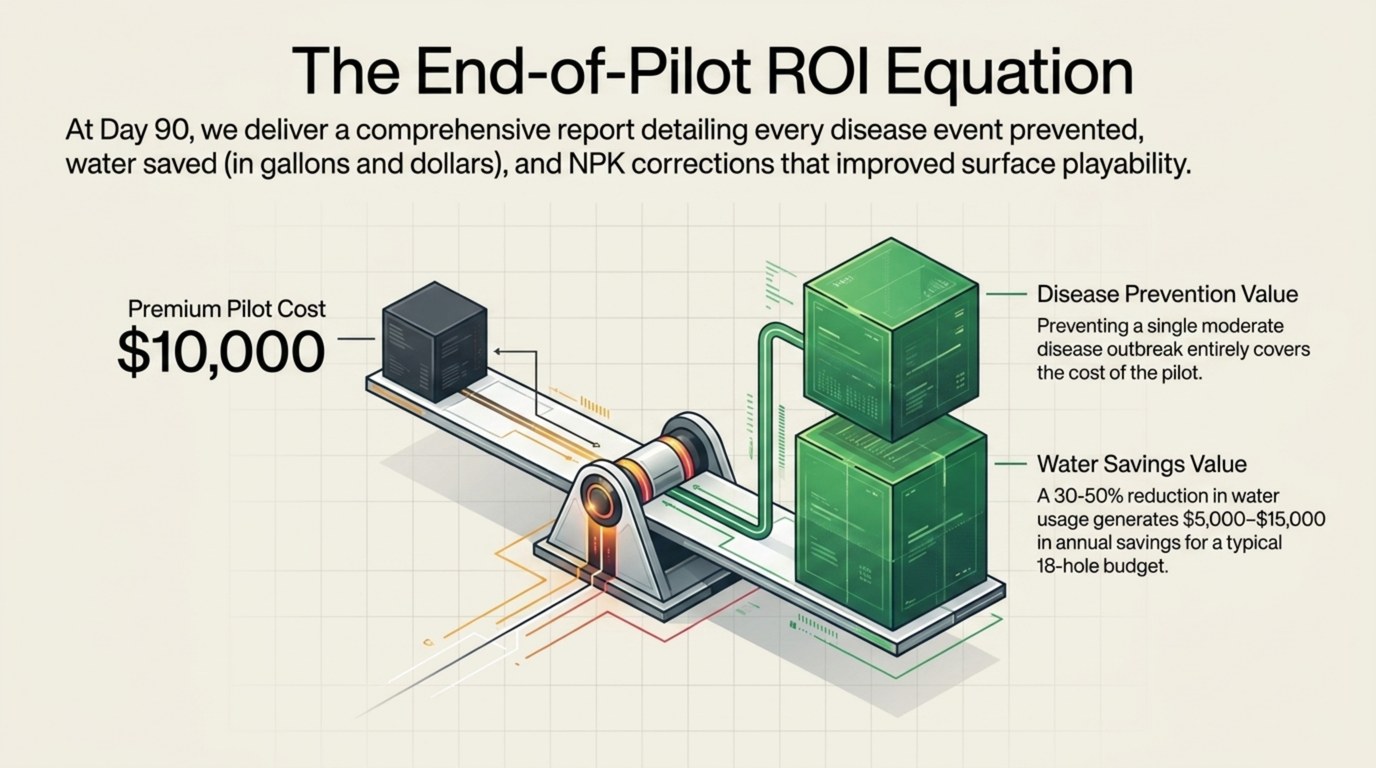
At the 90-day mark, the pilot delivers a comprehensive End-of-Pilot ROI Report — every disease event detected and prevented, water saved quantified in gallons and dollars, labor hours reduced, NPK corrections that improved playing surface quality, and a direct comparison of beginning and ending NDVI health scores zone by zone.
That report answers the question every greens committee will ask: was it worth it? Based on published turf management cost data, preventing even one moderate disease outbreak more than covers the entire pilot cost. Water savings alone at 30-50% reduction typically generate $5,000-$15,000 in annual savings at a typical 18-hole course water budget.
The report also includes a preview of what the autonomous TurfSentinel robot will do differently in 2027 — how the data collected during the pilot will directly inform the hardware's zone-specific measurement protocols, cutting frequencies, and disease risk thresholds for that specific course. Pilot clients receive first-access pricing on autonomous hardware at launch.
Getting a LawnSentinel for your home? Join the early access list.
Cook County residents get first delivery. No payment required now.
The Data This Pilot Produces
Here is something we want to be transparent about: this pilot is not only valuable for the golf courses that participate. It is valuable for TerraIQ's development process and federal grant applications.
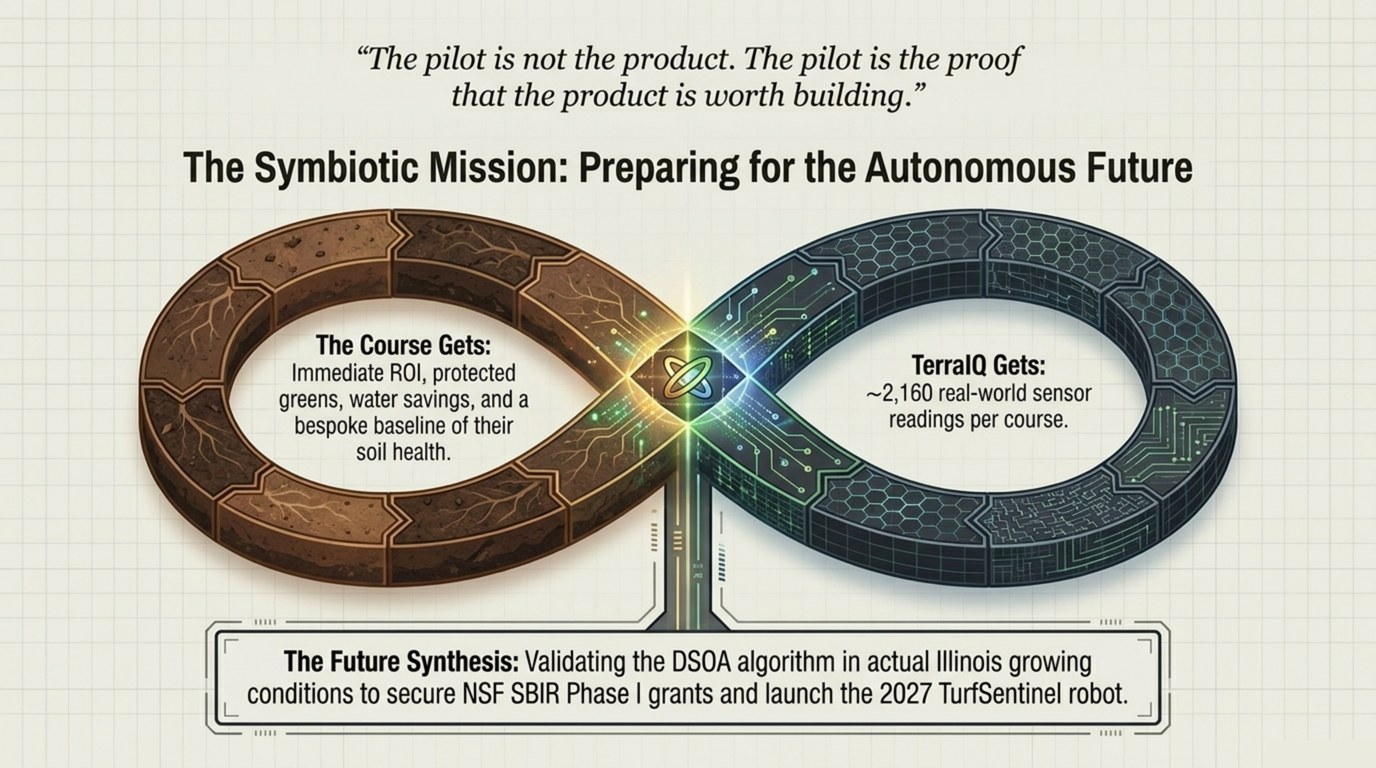
Every measurement visit at two 18-hole courses over 90 days generates approximately 2,160 individual sensor readings across 36 GPS-tagged zones. That is a real-world agronomic dataset — collected from actual professional turf, in actual Illinois growing conditions, across an actual summer season — that no competitor has and that no simulation can generate.
That dataset validates our DSOA algorithm's soil moisture modeling against real field conditions. It calibrates our disease risk models against actual infection events. It informs the sensor specifications for the autonomous hardware. And it provides the commercialization evidence that NSF SBIR Phase I applications require to score well — not projected customers, but documented paying customers with documented real-world data collection.
We are being transparent about this because we believe superintendents should know they are participating in something larger than a consulting engagement. They are co-developing the data foundation of the professional turf management platform that will eventually replace the manual intelligence work we are doing together this summer.
"The pilot is not the product. The pilot is the proof that the product is worth building."
Who This Is For
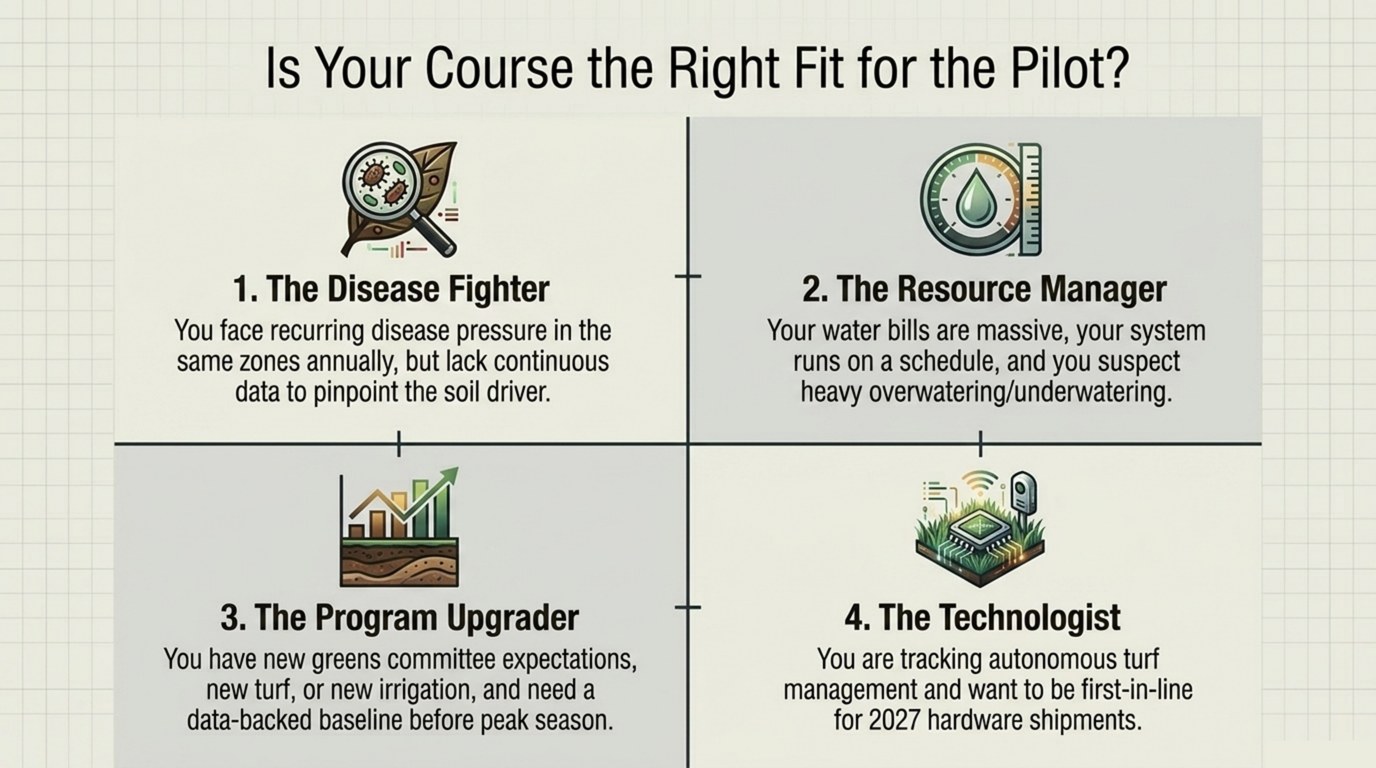
The TurfSentinel pilot is designed for golf course superintendents in the southwest Chicago suburbs who fit one of these profiles:
- You are dealing with recurring disease pressure — the same zones go down every year and you know something in the soil is driving it but you do not have the continuous data to confirm what.
- You are managing irrigation costs — water bills are significant, your irrigation system runs on a schedule, and you suspect you are overwatering some zones and underwatering others.
- You are upgrading your agronomic program — new installation, new irrigation system, or new greens committee expectations — and you want a data-backed baseline before the season peaks.
- You are interested in autonomous turf management technology and want to be at the front of the line when hardware ships.
How to Get One of the Two Slots
Contact us directly. Email info@terraiqinc.com or call 847-347-5510. We will schedule a 20-minute call, understand your course's specific agronomic challenges, and determine whether the pilot is the right fit. If it is, we will schedule the kickoff site walk and get started.
We are targeting summer 2026 start dates. Given the 90-day pilot window, courses starting in May or June will complete the pilot by August or September — capturing the full summer stress period when disease risk is highest and irrigation decisions matter most.
Both slots will be filled on a first-come, first-served basis once the contract is signed and the initial payment is received.